Tag: sell mirrorless camera

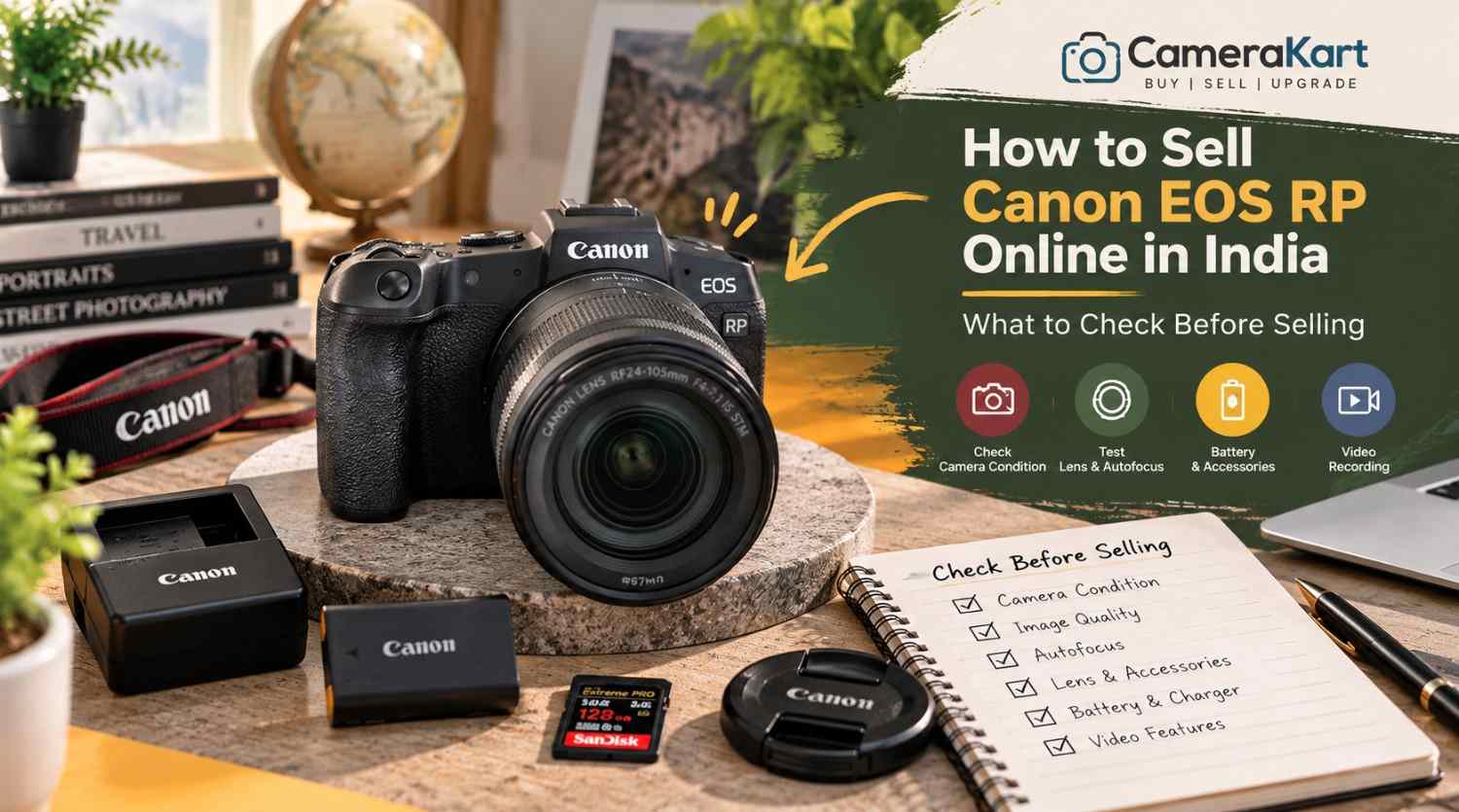
  • How to Sell Canon EOS RP Online in India: What to Check Before Selling

    How to Sell Canon EOS RP Online in India: What to Check Before Selling

    If you own a Canon EOS RP and are planning to upgrade your camera or switch to another system, selling your existing equipment can be a practical next step. Before you sell Canon EOS RP online, check the camera’s sensor performance, autofocus, display, recording functions, lens mount and included accessories.

    The Canon EOS RP is a compact full-frame mirrorless camera featuring a 26.2MP CMOS sensor, DIGIC 8 image processor, Dual Pixel CMOS AF and Canon RF lens compatibility. It can also use compatible EF and EF-S lenses with the appropriate mount adapter, making it relevant to photographers transitioning from a Canon DSLR.

    Because many EOS RP owners use their cameras for portraits, travel, family photography and everyday content creation, the inspection should cover both photography and video functions.

    This guide explains how to prepare your camera, identify its included equipment and start the selling process through CameraKart.

    1. Identify the Exact Camera Package

    Before requesting an offer, confirm whether you are selling the EOS RP body alone or including a lens.

    The camera uses Canon’s RF mount. If you previously used Canon DSLR lenses, you may also have an EF-EOS R mount adapter. Include it only if you intend to sell it with the camera.

    Make a list of the equipment you have:

    • Canon EOS RP camera body
    • RF or RF-S-compatible equipment where applicable; identify the exact lens model
    • Compatible EF lens and mount adapter, if included
    • Battery and charger
    • Body cap and lens caps
    • Camera strap
    • Original box and purchase invoice, if available
    • Additional batteries or other accessories

    If you are selling a body-only package, state that clearly. If you have an RF lens or DSLR lens with an adapter, record each model separately.

    A complete and accurate equipment list helps avoid confusion during inspection when you sell a used Canon EOS RP.

    2. Check the Full-Frame Sensor and Image Quality

    The EOS RP features a 26.2MP full-frame CMOS sensor. Before selling, take several photographs in different lighting conditions and inspect the saved images.

    Start with a well-lit subject, then photograph a darker scene. Review the results on the camera and, if possible, on a computer screen.

    Look for:

    • Persistent marks or spots in the same image area
    • Unusual lines or recurring colour defects
    • Unexpected image corruption
    • Problems saving photographs
    • Exposure behaviour that appears inconsistent

    A mark in a photograph does not necessarily mean the sensor is damaged. Dust on the lens, lighting conditions and shooting settings can affect image quality too.

    If a defect appears repeatedly, investigate carefully and disclose any unresolved issue. Avoid touching the sensor surface or attempting unfamiliar cleaning procedures just before selling.

    3. Test Autofocus and Subject Detection

    Autofocus is an important part of the EOS RP’s everyday photography performance. The camera uses Dual Pixel CMOS AF for supported still-image and video workflows.

    Take photographs of a stationary subject and a person moving around the frame. Test autofocus in suitable lighting and try different focus areas.

    Check whether:

    • The camera acquires focus consistently.
    • Focus points respond to your selections.
    • Face detection works as expected.
    • Touchscreen focus responds normally.
    • Autofocus operates with the included lens.
    • Any unusual warning appears.

    If focus seems inconsistent, repeat the test with suitable settings and a lens you know is functioning properly. A problem may originate from the lens or shooting conditions rather than the camera body.

    When you request an offer, mention any autofocus issue you have been unable to resolve.

    4. Inspect the LCD Screen, Viewfinder and Controls

    The EOS RP has a vari-angle touchscreen LCD and an electronic viewfinder. Both should be checked before you sell the camera.

    Inspect the LCD for cracks, lines, dark areas or touch-response problems. Move the screen gently through its normal range and confirm that the hinge works properly.

    Look through the electronic viewfinder and check that the image appears normally. Test the dioptre adjustment if you use it.

    Also inspect the:

    • Power switch and shutter button
    • Mode dial and control dials
    • Menu and function buttons
    • Touchscreen controls
    • Battery compartment
    • Memory-card door
    • Lens mount and tripod socket

    Check the body for impact marks, loose components or signs of liquid exposure. Cosmetic scratches are not necessarily functional faults, but significant damage should be disclosed.

    5. Check the Battery and Power Performance

    The EOS RP uses the LP-E17 battery. Battery condition matters because a camera that powers on may still have limited runtime or charging problems.

    Charge the battery using a suitable charger and test the camera under normal conditions. Check whether it powers on reliably, responds to controls and remains operational during a short photography session.

    Look for unexpected shutdowns, battery warnings or charging issues. Inspect the battery for visible swelling or damage; do not use a damaged battery.

    If you have an additional battery or the original charger, list them separately and identify which items you intend to include.

    Do not promise a particular battery runtime based on a brief test. Usage, screen brightness, temperature and recording settings all affect battery performance.

    6. Test Video Recording and Playback

    Although the EOS RP is often used for photography, it also supports video recording, including 4K recording with limitations that differ from its Full HD modes.

    If you have used the camera for interviews, family videos or content creation, test the recording modes you normally use.

    Insert a compatible memory card and record a short clip. Check that recording starts and stops correctly, the file saves and playback works.

    Pay attention to:

    • Recording errors
    • Files that fail to save
    • Unusual image defects
    • Audio recording problems
    • Screen or control issues during recording
    • Unexpected warnings

    Do not assume every video mode works properly because one short clip recorded successfully. If you encounter a recurring problem, make a note of the exact setting and behaviour.

    7. Inspect the Lens Mount and Any Included Lens

    If your EOS RP is being sold with a lens, inspect that lens independently from the body.

    Check the front and rear glass for visible scratches, haze or fungus. Inspect the barrel, zoom ring, focus ring and mount for damage. Test autofocus and take a few sample photographs where possible.

    If you are including an EF-EOS R adapter, inspect its contacts and exterior for visible damage. Do not force a lens or adapter into the mount.

    Clearly identify the lens model and whether it is included in the offer request. If the camera is body-only, state that instead of suggesting a lens is part of the package.

    8. Check the Ports, Memory Card and Flash Accessories

    Before selling, test the functions and connections you regularly use.

    The EOS RP has a memory-card slot and connections that support workflows such as USB data transfer, HDMI output and external microphone input. Test relevant connections only when you have suitable cables or equipment.

    Check that:

    • The memory card is recognised.
    • Photographs and videos save correctly.
    • Files play back normally.
    • The USB connection works where tested.
    • HDMI output works if you can test it.
    • External microphone input works if you use one.

    If you have an external flash or other compatible accessory, inspect it separately and include it in your equipment list only if you intend to sell it.

    If a port has not been tested, say so. If it is damaged or repeatedly fails, disclose that issue rather than describing the camera as fully functional.

    9. Prepare Your Camera Details and Photographs

    Before you sell Canon EOS RP online in India, prepare the information needed to identify the camera and describe its condition accurately.

    Keep these details ready:

    • Exact model: Canon EOS RP
    • Body-only or lens package
    • Lens and adapter details, if included
    • Physical condition
    • Autofocus and image-quality test results
    • Video and connectivity test results
    • Known faults or previous repairs
    • Invoice and box availability
    • Pickup location, if requested by the service

    Take clear photographs of the front, rear screen, top controls, base, lens mount and included accessories. Use even lighting and avoid editing images in ways that hide damage.

    Back up your important photographs and videos before handing over the camera. Remove your memory card and disconnect personal wireless connections where appropriate. If you are ready to clear your settings, follow Canon’s instructions for resetting the camera.

    10. Where Can You Sell a Used Canon EOS RP?

    You can consider private buyers, online marketplaces or specialist camera-buying services.

    A private sale allows direct communication and negotiation, but you may need to manage enquiries, arrange demonstrations and verify payment yourself. Marketplace processes and buyer experiences can vary.

    A specialist camera-buying service may offer a more structured process for submitting model details, receiving an estimate and arranging an inspection.

    Before choosing a service, check whether the initial estimate is provisional, how the final offer is determined, whether pickup is available in your area and when payment is made.

    Avoid assuming that the original purchase price or another seller’s listing guarantees your final offer. The camera’s condition, included equipment and inspection results all matter.

    11. Start Selling Your Canon EOS RP Through CameraKart

    You can begin with CameraKart’s dedicated Canon EOS RP model page:

    Sell Canon EOS RP Online with CameraKart

    Review the available selling steps and provide accurate details about your camera and package.

    CameraKart describes its general process as requesting an estimate, arranging pickup where available and completing payment after technician inspection. Confirm the current terms and pickup availability for your area before proceeding.

    Treat the initial estimate as provisional until the camera has been assessed. Providing clear details about the body, lens and accessories can help ensure the inspection reflects the package you intend to sell.
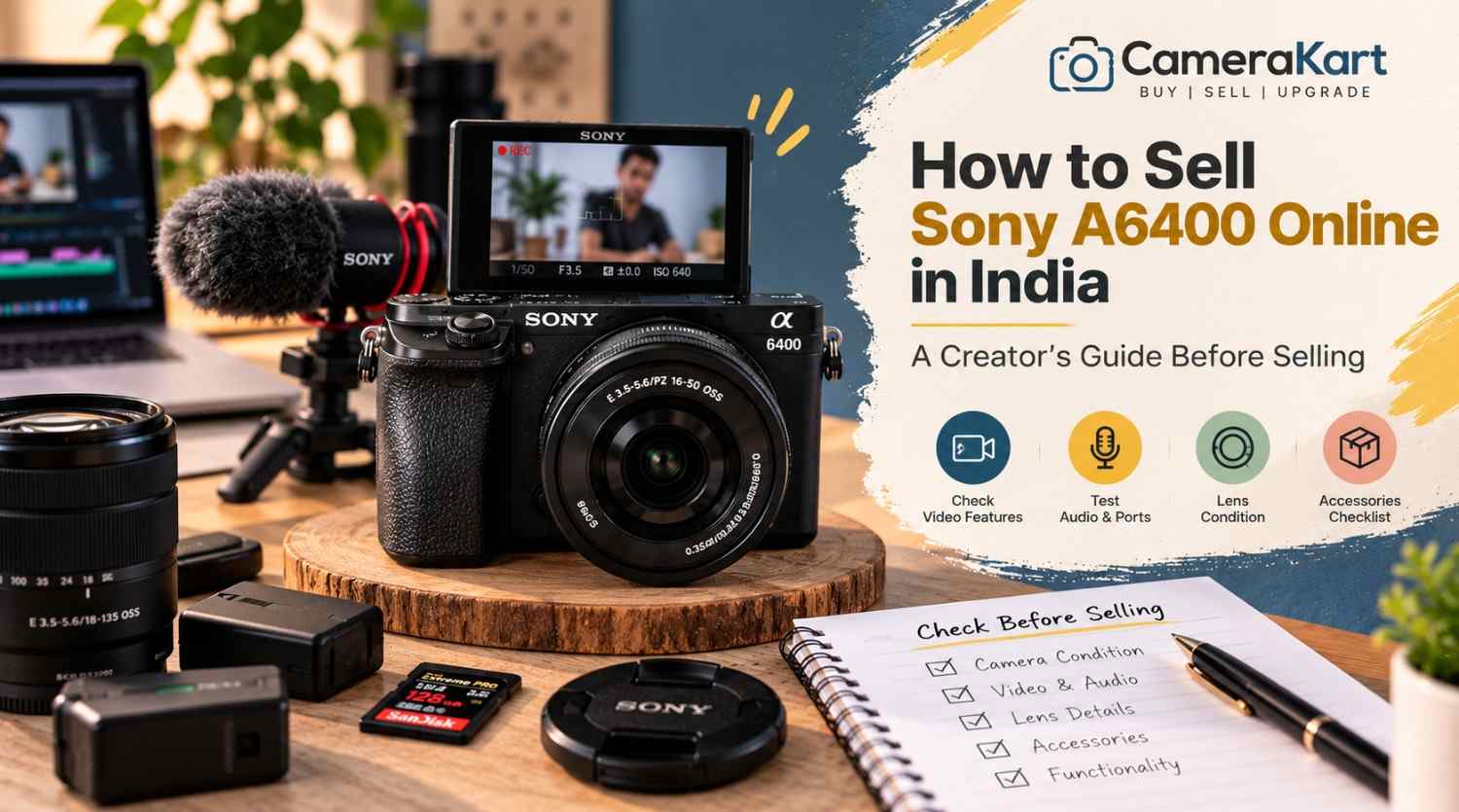
  • How to Sell Sony A6400 Online in India: A Creator’s Guide Before Selling

    How to Sell Sony A6400 Online in India: A Creator’s Guide Before Selling

    If you’re a photographer, YouTuber, vlogger or content creator who owns a Sony A6400, there may come a point when your current camera no longer fits your setup.

    You may have upgraded to a newer Sony body, moved to full-frame, purchased a dedicated video camera, or simply stopped using the A6400 regularly.

    When that happens, selling the camera can be a practical way to move on from equipment that’s sitting unused.

    But if you’re planning to sell Sony A6400 online, don’t evaluate it only like a traditional still-photography camera.

    The A6400 has several features that are particularly relevant to creators, including a 24.2MP APS-C sensor, Fast Hybrid AF, 425 phase-detection and 425 contrast-detection AF points, 4K video recording, a 180-degree tilting LCD and microphone connectivity. Sony also lists continuous shooting up to 11 fps. Sony India

    That means a creator should check both photography and video functionality before selling.

    Here’s a practical guide.

    1. Start by Identifying the Exact A6400 Kit

    Before you sell used Sony A6400, first establish exactly what you’re selling.

    Your setup might include:

    • Sony A6400 body
    • 16–50mm kit lens
    • 18–135mm lens
    • Prime lens
    • Extra battery
    • Charger
    • Camera strap
    • Body cap
    • Lens cap
    • Memory card
    • Camera bag
    • Original box

    Don’t describe everything as simply “Sony A6400.”

    For example:

    Sony A6400 + 16–50mm lens + original battery + charger

    gives a much clearer picture of the equipment being submitted.

    2. Check the Camera Body for Creator-Use Wear

    Creators often use cameras differently from occasional photographers.

    An A6400 used for vlogging may have spent a lot of time:

    • On a tripod
    • Inside a camera cage
    • Attached to a microphone
    • Mounted on a gimbal
    • Connected to an HDMI monitor
    • Used outdoors

    So inspect areas that may have experienced regular handling.

    Check:

    • Camera grip
    • Tripod mount
    • Hot shoe
    • Battery door
    • HDMI/USB area
    • Microphone port
    • Mode dial
    • Control dials
    • Screen hinge

    Minor cosmetic wear isn’t necessarily a major problem.

    What matters more is whether any damage affects normal operation.

    3. Test the 180-Degree Tilting Screen

    One of the most useful A6400 features for creators is its 180-degree tilting LCD.

    Sony’s specifications list a 3-inch LCD monitor with approximately 921,600 dots and a 180-degree tilting mechanism. Sony India

    If you used your A6400 for selfies, vlogging or talking-head videos, this screen has probably been used frequently.

    Check:

    • Screen opens smoothly
    • Screen holds its position
    • Display remains normal
    • No flickering
    • No lines
    • No cracked areas
    • Menu and playback work correctly

    Also move the screen carefully rather than forcing it beyond its intended movement.

    4. Test Autofocus for Both Photos and Video

    Autofocus is one of the important reasons creators choose the A6400.

    Sony lists a Fast Hybrid AF system with 425 phase-detection AF points and 425 contrast-detection AF points. Sony India

    Test autofocus with the lens you’re selling.

    Try:

    • Static subjects
    • Moving subjects
    • Face detection
    • Eye AF where supported
    • Close subjects
    • Distant subjects

    For a creator camera, don’t test autofocus only through still photographs.

    Record a short video and see whether focus behaves normally while the subject moves.

    5. Test the Camera’s 4K Recording

    If you’re planning to sell Sony A6400 online in India, video recording deserves special attention.

    The A6400 supports 4K recording, making it relevant for creators who use the camera for YouTube, product videos, travel content and other video work. Sony’s current product material lists 4K HDR and the camera’s creator-oriented specifications. Sony India

    Record a short 4K clip.

    Check:

    • Recording starts normally
    • Video saves correctly
    • Playback works
    • Audio is captured
    • Autofocus behaves normally
    • Camera doesn’t unexpectedly stop

    You don’t need to record a 30-minute video.

    A short test is enough to identify obvious issues.

    6. Check the Microphone Connection

    If you’ve used the A6400 for YouTube or professional content, the microphone connection is especially important.

    Connect your microphone and record a short clip.

    Check whether:

    • Microphone is detected
    • Audio is recorded
    • Connection is stable
    • Cable fits correctly
    • There is unusual noise or intermittent audio

    If you normally used an external microphone, this is one of the tests worth performing before you sell used Sony A6400.

    A camera can capture excellent video while still having an issue with an external audio connection.

    7. Check the HDMI and USB Connections

    Creators sometimes connect cameras to computers, capture devices or external monitors.

    Therefore, don’t overlook the physical ports.

    Inspect the relevant connections for:

    • Loose ports
    • Physical damage
    • Bent components
    • Connection problems

    If you regularly used the camera for streaming or external monitoring, test the connection you used most frequently.

    There’s no need to repeatedly insert and remove cables just for testing.

    One careful test is sufficient.

    8. Test the Lens You Are Selling With It

    If you’re selling an A6400 with a lens, the lens needs its own inspection.

    Check:

    • Front glass
    • Rear glass
    • Zoom ring
    • Focus ring
    • Autofocus
    • Mount
    • Image stabilization, if supported
    • Filter thread

    Look for:

    • Fungus
    • Haze
    • Heavy dust
    • Scratches
    • Cracks

    If you’re including a 16–50mm kit lens, mention the exact lens model rather than simply writing “kit lens.”

    If you have an additional prime or zoom lens, list that separately.

    9. Test Stabilization Where Applicable

    Some A6400-compatible lenses include optical stabilization.

    If the lens you’re selling has stabilization, test it.

    Take a few handheld photographs and, if relevant, record a short handheld video.

    Listen for unusual sounds and check whether the stabilization behaves normally.

    Remember that the camera body itself isn’t being evaluated as an in-body stabilization camera in the same way as models that have IBIS. So distinguish between lens stabilization and camera-body stabilization when describing your equipment.

    10. Check Battery Performance

    The A6400 uses the Sony NP-FW50 battery system.

    Before you sell Sony A6400, check whether:

    • Battery charges properly
    • Camera powers on consistently
    • Battery drains unusually quickly
    • Charger works
    • Battery has any physical swelling or damage

    If you have an additional genuine battery, include it in your equipment list.

    If the battery is older and doesn’t perform like it once did, simply mention its condition rather than assuming it is still like new.

    11. Test the Memory Card and File Recording

    Creators often record large video files, so memory-card functionality matters.

    Insert a compatible memory card and record:

    • A photograph
    • A short Full HD clip
    • A short 4K clip

    Then check whether the files save and play correctly.

    If you regularly used a high-capacity card with the camera, remember to remove your personal card before selling.

    Your personal photographs and video files should always be backed up first.

    12. Check the Hot Shoe and Accessories

    If you’ve used the A6400 for content creation, you may have attached:

    • Microphone
    • Flash
    • LED light
    • Wireless receiver
    • Other accessories

    Inspect the hot shoe for physical damage.

    Also gather the accessories you are actually selling.

    Your list could look like:

    Included:
    A6400 body + 16–50mm lens + battery + charger + strap.

    Additional:
    Extra battery + camera bag.

    This is much clearer than simply saying “all accessories included.”

    13. Test the Electronic Viewfinder

    Although creators may use the LCD more often, the A6400 also has an electronic viewfinder.

    Check:

    • Display quality
    • Flickering
    • Lines
    • Visibility
    • Eye sensor behaviour

    A feature that you rarely use can still be part of the camera’s overall condition.

    14. Check the Camera’s Physical Mounts

    If you frequently used the A6400 on a tripod, gimbal or cage, inspect the mounting points.

    Pay particular attention to:

    • Tripod mount
    • Camera base
    • Cage contact points
    • Strap lugs

    Make sure there are no cracks or loose components.

    A camera used heavily for content creation may show more wear around these areas than a camera used primarily handheld.

    15. Don’t Forget Your Personal Creator Settings

    Before selling your camera, back up anything you need and then consider resetting the camera to its normal/default state.

    Your A6400 may contain:

    • Custom button assignments
    • Wi-Fi information
    • Personal shooting settings
    • Custom picture profiles
    • Saved network information

    Most importantly, remove your memory card and make sure personal files are backed up.

    You don’t want your personal data travelling with the camera.

    16. Be Honest About Heavy Creator Use

    A camera used professionally isn’t automatically a bad camera.

    For example, an A6400 may have been used frequently for:

    • YouTube
    • Vlogging
    • Weddings
    • Product photography
    • Travel
    • Social-media content

    Usage itself doesn’t tell the complete story.

    What matters is the actual current condition.

    If the camera has been heavily used but all major functions work properly, describe that honestly.

    17. Prepare a Simple Creator-Specific Checklist

    Before you sell Sony A6400 online, go through this list:

    AreaWhat to Check
    BodyScratches, dents, cracks
    LCD180° movement and display
    EVFDisplay and sensor
    AutofocusPhoto + video AF
    4KRecording and playback
    AudioMicrophone input
    HDMI/USBConnection
    LensGlass, focus and zoom
    BatteryCharging and power
    MemoryRecording and playback
    Hot ShoePhysical condition
    Tripod MountDamage or looseness
    AccessoriesBattery, charger, caps, lens
    Personal DataBackup and remove card

    This checklist is particularly useful if you’ve used your A6400 as a creator camera rather than only for photography.

    Where to Sell Sony A6400 Online

    Once you’ve tested the camera and gathered the equipment, you can start the selling process through CameraKart’s dedicated Sony A6400 page:

    Sell Sony A6400:
    Sell Sony A6400 on CameraKart

    Using the dedicated model page helps you submit the correct camera rather than selecting a generic Sony camera category.

    Final Thoughts

    If you’re ready to sell Sony A6400 online, don’t prepare it like you’re selling only a camera body.

    Think about how you’ve actually used it.

    If you’re a creator, check the 180-degree screen, autofocus, 4K recording, microphone connection, HDMI/USB ports, lens, battery and memory-card recording before submitting the camera.

    The A6400’s 24.2MP APS-C sensor, Fast Hybrid AF with 425 phase-detection and 425 contrast-detection points, 4K capability and creator-friendly screen make these checks particularly relevant. Sony India

    Gather your accessories, back up your content, remove your personal memory card and accurately describe the camera’s condition.

    Then you’re ready to move forward with your selling request.

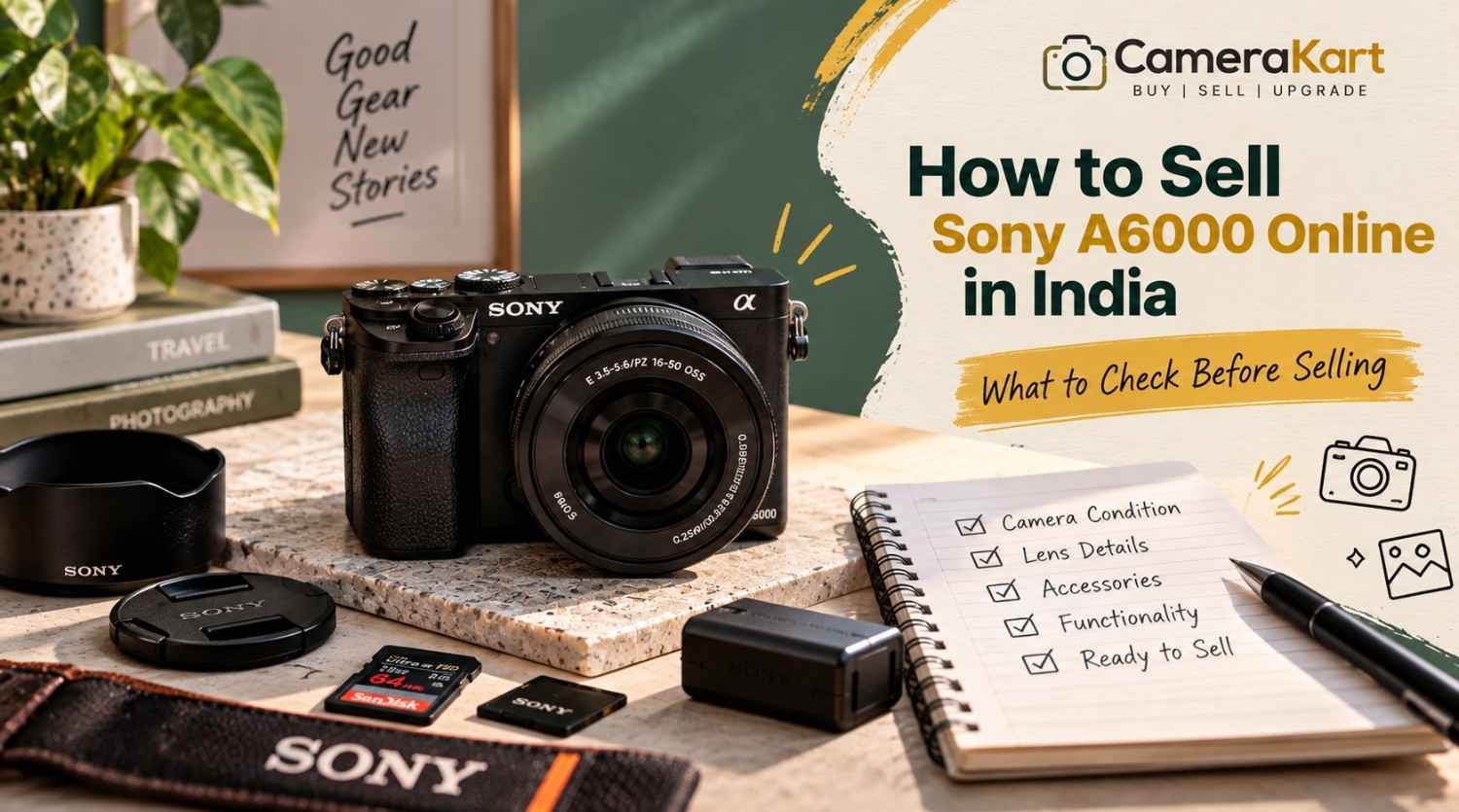
  • How to Sell Sony A6000 Online in India: What to Check Before Selling

    How to Sell Sony A6000 Online in India: What to Check Before Selling

    If you own a Sony A6000 and are thinking about upgrading to a newer camera, switching systems, or simply selling equipment that you no longer use, preparing the camera properly can make the selling process much easier.

    The Sony A6000 is an APS-C mirrorless camera with a 24.3MP effective-resolution sensor, Sony E-mount, Fast Hybrid AF, built-in Wi-Fi and NFC, an electronic viewfinder and a built-in flash. Sony’s specifications also list continuous shooting of up to 11 fps. Sony India

    Because the A6000 is an interchangeable-lens camera, you should not think about the camera body alone when preparing to sell Sony A6000 online. The lens, battery, charger, LCD, viewfinder, autofocus, memory-card slot and physical condition can all be relevant.

    Before you submit your camera, use the following checklist.

    1. Confirm the Exact Sony A6000 Model

    The first step is to make sure you have the correct camera model.

    Sony identifies the A6000 as ILCE-6000. It uses Sony’s E-mount system and an APS-C Exmor APS HD CMOS sensor with approximately 24.3 effective megapixels. Sony India

    This matters because Sony has produced many cameras with similar names and appearances.

    Before you sell used Sony A6000, check the camera body, box or original documentation to confirm the exact model.

    Keep these details ready:

    • Brand
    • Model
    • Body only or complete kit
    • Lens model
    • Accessories included
    • Known condition issues

    Getting the model right prevents confusion when starting the selling request.

    2. Check the Physical Condition of the Body

    Start with a simple visual inspection.

    Look at the:

    • Front body panel
    • Rear panel
    • Top plate
    • Bottom plate
    • Grip
    • Battery door
    • Memory-card compartment
    • Hot shoe
    • Lens mount

    Older cameras naturally show signs of use.

    Small scratches or minor paint wear aren’t necessarily the same as functional damage.

    Pay more attention to:

    • Cracks
    • Deep dents
    • Loose parts
    • Broken doors
    • Damaged buttons
    • Significant impact marks

    If your Sony A6000 has normal signs of use, describe them honestly rather than trying to make the camera appear unused.

    3. Test the 24.3MP Sensor

    The Sony A6000 has an APS-C Exmor APS HD CMOS sensor with approximately 24.3 effective megapixels. Sony India

    Before you sell Sony A6000 online in India, take several test photographs.

    A plain wall or evenly lit surface can make image issues easier to notice.

    Check whether you see:

    • Persistent dark spots
    • Lines
    • Unusual artifacts
    • Abnormal colours
    • Exposure problems
    • Other issues appearing consistently in images

    A little dust on a sensor can happen with interchangeable-lens cameras. Don’t attempt aggressive sensor cleaning if you aren’t experienced with it.

    The objective is to understand the camera’s condition, not to perform complicated repairs before selling.

    4. Test the Autofocus

    Autofocus is an important part of the A6000.

    Sony lists the camera’s Fast Hybrid AF system with 179 phase-detection points and 25 contrast-detection points. Sony India

    Test autofocus using:

    • A nearby object
    • A distant object
    • A stationary subject
    • A moving subject
    • Different lighting conditions

    If you’re selling the camera with a lens, test autofocus with that lens as well.

    If autofocus works correctly with one lens but not another, the issue may be related to the lens rather than the camera body.

    That distinction is useful when you sell used Sony A6000.

    5. Check the 11 fps Continuous Shooting

    The A6000 can shoot at up to approximately 11 frames per second in its high continuous shooting mode. Sony India

    You don’t need to perform an extensive test.

    Simply switch to continuous shooting and take a short burst.

    Check whether:

    • The shutter responds normally
    • Images are captured
    • Files save correctly
    • The camera doesn’t freeze unexpectedly

    If everything works normally, move on to the next check.

    6. Inspect the LCD Screen

    Sony lists the A6000 with a 3-inch TFT monitor and approximately 921,600 dots. Sony India

    Check the screen carefully for:

    • Cracks
    • Lines
    • Flickering
    • Dead areas
    • Brightness problems
    • Physical damage

    Turn the camera on and browse through the menus and photographs.

    Make sure the controls respond properly and that playback works.

    A screen can look fine when the camera is switched off but show problems once it is powered on, so always test it while operating the camera.

    7. Test the Electronic Viewfinder

    The A6000 has an electronic viewfinder with approximately 1.44 million dots and 100% field coverage. Sony India

    Look through the EVF and check whether the display appears normal.

    Pay attention to:

    • Flickering
    • Lines
    • Display abnormalities
    • Visibility problems
    • Unusual colour behaviour

    If the EVF and LCD both work normally, include that in your overall condition assessment.

    8. Check the E-Mount and Lens Connection

    The A6000 uses Sony E-mount lenses. Sony India

    Remove the lens carefully and inspect the mount.

    Look for:

    • Physical damage
    • Loose components
    • Bent areas
    • Communication problems
    • Difficulty attaching or removing the lens

    Then attach the lens again and check whether the camera recognizes it correctly.

    Don’t repeatedly force the lens on and off just to test it.

    One careful inspection is enough.

    9. Inspect the Lens Separately

    If you’re selling your Sony A6000 with a lens, the lens should have its own condition check.

    Look at:

    • Front glass
    • Rear glass
    • Zoom ring
    • Focus ring
    • Autofocus
    • Mount
    • Filter thread

    Also check for visible:

    • Fungus
    • Haze
    • Cracks
    • Heavy scratches

    If you’re including the common 16–50mm kit lens or another E-mount lens, mention the exact lens model in your submission.

    Don’t simply write “Sony A6000 with lens.”

    A more useful description is:

    Sony A6000 + Sony E 16–50mm lens + battery + charger.

    10. Check the Battery and Charger

    The A6000 uses Sony’s NP-FW50 rechargeable battery. Sony’s specifications list approximately 310 shots using the viewfinder or approximately 360 shots using the LCD under CIPA testing conditions. Sony India

    Actual battery performance depends on battery age and usage.

    Before you sell Sony A6000 online, check:

    • Does the battery charge?
    • Does the camera power on?
    • Does the battery drain unusually quickly?
    • Does the charger work?
    • Is the battery physically damaged?

    If you have the original charger, keep it with the camera.

    11. Test the Memory Card Slot

    Insert a compatible memory card and take a few photographs.

    Sony lists support for Memory Stick and SD-series cards, including SDHC and SDXC cards. Sony India

    Check whether:

    • Photos save correctly
    • Playback works
    • Files can be transferred
    • The card is recognized consistently

    This is a quick test but can identify an issue that might otherwise be overlooked.

    12. Check Wi-Fi and NFC Features

    The Sony A6000 includes built-in Wi-Fi and NFC functionality. Sony India

    You don’t necessarily need to spend a lot of time testing wireless functions.

    However, if you regularly use them, it’s worth checking that the camera behaves normally.

    For example, test whether the camera can establish its expected wireless connection with a compatible device.

    If wireless functions don’t work, note the issue rather than assuming everything is fine.

    13. Test Video Recording

    The A6000 supports Full HD video recording, including AVCHD and MP4 recording options. Sony India

    Record a short clip and check:

    • Recording starts normally
    • The file saves
    • Playback works
    • Audio is captured
    • The camera doesn’t unexpectedly stop

    A short test is sufficient.

    You don’t need to record a long video simply to check the function.

    14. Check the Built-In Flash

    Unlike some compact mirrorless cameras, the A6000 includes a built-in flash. Sony lists the camera with a built-in flash system. Sony India

    Pop up the flash and take a test photograph.

    Check whether it fires normally.

    If you don’t use the flash regularly, it’s easy to forget about this function when preparing the camera for sale.

    15. Collect the Accessories

    Before you sell used Sony A6000, gather everything you still have.

    This could include:

    • Camera body
    • Lens
    • Battery
    • Charger
    • USB cable
    • Camera strap
    • Body cap
    • Lens cap
    • Original box
    • Manuals
    • Camera bag
    • Additional battery

    You don’t need to have every original accessory.

    Simply make a clear list of what you’re actually including.

    16. Remove Your Personal Memory Card

    Before handing over the camera, remove your memory card.

    Also back up your photographs and videos.

    Your camera may contain years of personal photographs, so don’t assume that removing the camera’s battery is enough to protect your data.

    Before the pickup or handover:

    Back up → remove memory card → check camera → pack equipment.

    This simple sequence can prevent an unnecessary mistake.

    17. Mention Known Issues Honestly

    If the camera has an issue, mention it.

    For example:

    • LCD has a scratch
    • Battery doesn’t hold charge for long
    • One button is inconsistent
    • Lens has visible fungus
    • Wi-Fi isn’t working
    • Body has a dent

    Don’t describe the camera as “perfect” when you already know there is a functional problem.

    When you sell Sony A6000 online, accurate information is more useful than an exaggerated description.

    18. Don’t Judge the Camera Only by Its Age

    The A6000 is an older camera, but age alone doesn’t tell you everything about the equipment’s condition.

    Two A6000 bodies can have very different usage histories.

    One might have:

    • Clean body
    • Good sensor
    • Working autofocus
    • Good battery
    • Clean lens

    while another could have:

    • Heavy cosmetic wear
    • Battery issues
    • Lens problems
    • Damaged controls

    That’s why you should evaluate your actual camera rather than assuming that every A6000 should be treated identically.

    What Information Should You Keep Ready?

    Before you submit your Sony A6000, prepare these details:

    InformationWhat to Provide
    ModelSony A6000 / ILCE-6000
    Camera TypeAPS-C Mirrorless
    Body ConditionGood / Used / Damaged
    LensExact lens model
    BatteryIncluded / condition
    ChargerIncluded / unavailable
    Shutter CountIf available
    LCDWorking / issue
    EVFWorking / issue
    AutofocusWorking / issue
    SensorNormal / issue
    VideoTested / issue
    AccessoriesComplete list
    Known IssuesMention clearly

    Having this information ready makes the selling request much easier to complete.

    Where to Sell Sony A6000 Online?

    If you’re ready to sell Sony A6000 online, CameraKart has a dedicated model page for the camera:

    Sell Sony A6000:
    Sell Sony A6000 on CameraKart

    Before submitting the request, keep your camera’s condition, lens information and accessories ready.

    The dedicated model page also gives you a more direct path than starting with a generic camera category.

    Sony A6000 Selling Checklist

    Before you submit the camera, quickly confirm:

    • ✓ Exact model identified
    • ✓ Body condition checked
    • ✓ Sensor tested
    • ✓ Autofocus tested
    • ✓ Shutter tested
    • ✓ LCD checked
    • ✓ EVF checked
    • ✓ E-mount inspected
    • ✓ Lens tested
    • ✓ Battery checked
    • ✓ Charger checked
    • ✓ Memory-card slot tested
    • ✓ Video recording tested
    • ✓ Flash tested
    • ✓ Accessories collected
    • ✓ Personal memory card removed
    • ✓ Known issues noted

    Final Thoughts

    If you’re planning to sell Sony A6000 online in India, don’t rush directly to the selling request.

    Spend a few minutes checking the camera first.

    The Sony A6000 combines a 24.3MP APS-C sensor, E-mount compatibility, Fast Hybrid AF, 11 fps continuous shooting, an electronic viewfinder, built-in flash and wireless connectivity. Sony India

    Those features make it especially important to check both the camera body and the included lens before you sell.

    Test the major functions, collect your accessories, remove your personal memory card and be transparent about any known issues.

    Once everything is ready, you can submit your camera through CameraKart’s dedicated Sony A6000 selling page and begin the selling process.

  • How to Sell Sony A7 II Online in India: A Practical Guide Before Selling

    How to Sell Sony A7 II Online in India: A Practical Guide Before Selling

    If you own a Sony A7 II and are considering an upgrade, changing your camera system, or simply want to sell equipment that you no longer use, it is worth preparing the camera properly before submitting it for an offer.

    The Sony A7 II was an important full-frame mirrorless camera in Sony’s Alpha lineup. It features a 24.3MP full-frame Exmor CMOS sensor, Sony E-mount, 5-axis sensor-shift image stabilization, Fast Hybrid AF and a maximum continuous shooting speed of approximately 5 fps.

    Because it is an interchangeable-lens camera, the selling process isn’t only about the camera body. The condition of the sensor, mount, shutter, stabilization system, battery, LCD, viewfinder and any included lens can all matter when you sell Sony A7 II online.

    Here’s what you should check before selling yours.

    1. Confirm Exactly What You Are Selling

    Start by identifying the exact equipment you have.

    The Sony A7 II is also identified by Sony as model ILCE-7M2. Sony’s support documentation lists it as the Alpha 7 II full-frame interchangeable-lens camera body.

    Before submitting your details, make a simple inventory:

    • Sony A7 II body
    • Lens or lenses
    • Battery
    • Charger
    • USB cable
    • Body cap
    • Lens cap
    • Camera strap
    • Original box
    • Manuals
    • Extra accessories

    This prevents confusion later and makes your submission more accurate.

    2. Inspect the Camera Body

    The first physical check should be the camera body itself.

    Look carefully at:

    • Front and rear panels
    • Camera grip
    • Top plate
    • Bottom plate
    • Battery door
    • Memory-card compartment
    • Hot shoe
    • Lens mount
    • Buttons and dials

    Small scratches from normal use aren’t unusual on an older mirrorless camera.

    What deserves more attention is major physical damage such as cracks, deep dents, loose components or signs of a significant impact.

    If your A7 II has cosmetic wear but functions properly, simply describe the condition accurately when you sell used Sony A7 II.

    3. Test the Full-Frame Sensor

    The A7 II uses a 35mm full-frame Exmor CMOS sensor with approximately 24.3 effective megapixels.

    Before selling, take several photographs against a plain, evenly lit surface.

    Review the images at 100% if possible and look for:

    • Persistent dark spots
    • Unusual lines
    • Image artifacts
    • Abnormal colour issues
    • Exposure inconsistencies
    • Other problems visible in every frame

    Don’t confuse ordinary removable dust with a major sensor fault.

    If you aren’t experienced with sensor cleaning, avoid aggressive DIY cleaning immediately before selling. A simple condition check is usually more useful than taking unnecessary risks.

    4. Check the 5-Axis Stabilization

    One of the features worth specifically checking on the A7 II is its in-body image stabilization.

    Sony specifies a sensor-shift mechanism with 5-axis compensation and a rated compensation effect of up to 4.5 steps under its stated test conditions.

    Take a few handheld photographs at slower shutter speeds and compare the results.

    You’re mainly checking whether the stabilization system behaves normally rather than trying to measure its exact performance.

    If you notice unusual noises, warnings or inconsistent stabilization, make a note of it.

    This is particularly important because it is a feature specific to the camera body, not something you should assume is functioning simply because the camera powers on.

    5. Test the Shutter and Shooting Controls

    The A7 II supports shutter speeds from 1/8000 second to 30 seconds, plus Bulb mode, and its maximum continuous shooting speed is approximately 5 fps.

    Take photographs using:

    • Single shooting
    • Continuous shooting
    • Different shutter speeds
    • Different exposure modes

    Check whether the shutter responds normally.

    Also test the main dials and buttons.

    Pay attention to:

    • Shutter button
    • Control dials
    • Mode dial
    • Menu button
    • Playback
    • Navigation controls
    • Custom buttons

    A camera can look excellent externally while having a faulty button or dial, so testing the controls is worth doing before you sell Sony A7 II online in India.

    6. Check Autofocus With Your Lens

    7. Inspect the E-Mount

    The A7 II uses Fast Hybrid AF with phase-detection and contrast-detection AF. Sony lists 117 phase-detection points and 25 contrast-detection points for the full-frame shooting area.

    If you’re selling the camera with a lens, test autofocus using that lens.

    Try:

    • A nearby subject
    • A distant subject
    • Static objects
    • Moving subjects
    • Different lighting conditions

    If the body focuses correctly but the lens has an issue, the two problems shouldn’t be treated as the same thing.

    That’s why testing the body and lens separately can give you a much clearer picture of what you’re actually selling.

    The Sony A7 II uses Sony E-mount lenses.

    The mount should be inspected carefully because it’s where the camera body and lens physically connect.

    Check for:

    • Bent or damaged mount components
    • Loose fitting
    • Excessive play
    • Visible damage
    • Problems communicating with the lens

    Remove and attach the lens carefully.

    Don’t repeatedly force a lens onto the mount just to test it. One proper check is enough.

    8. Test the Electronic Viewfinder and LCD

    The A7 II features an XGA OLED electronic viewfinder with approximately 2.36 million dots and a 3-inch TFT LCD monitor.

    Turn the camera on and inspect both.

    Check the EVF for:

    • Display abnormalities
    • Flickering
    • Unusual lines
    • Visibility problems

    Then inspect the LCD for:

    • Cracks
    • Dead areas
    • Display lines
    • Brightness issues
    • Physical damage

    Also test the screen controls and playback functionality.

    9. Check the Battery and Charger

    The A7 II uses Sony’s NP-FW50 rechargeable battery. Sony lists approximately 270 shots using the viewfinder or approximately 350 shots using the LCD under its CIPA test conditions.

    Real-world battery performance will vary with age and usage.

    Before you sell Sony A7 II, check:

    • Does the battery charge?
    • Does the camera power on reliably?
    • Does the battery drain unusually quickly?
    • Does the charger work?
    • Is the battery physically damaged?

    If you have the original charger, include it in your equipment list.

    10. Test the Memory Card and Connections

    The A7 II supports SD, SDHC and SDXC memory cards, including UHS-I-compatible SD cards.

    Insert a compatible card and take a few photographs.

    Confirm that:

    • Images save correctly
    • Playback works
    • Files can be transferred
    • The memory-card slot behaves normally

    The camera also includes USB, HDMI, microphone and headphone connectivity.

    You don’t need to test every port repeatedly, but checking the important connections is a useful part of preparing the camera.

    11. Don’t Forget Video Recording

    The A7 II supports Full HD video recording through formats including XAVC S and AVCHD.

    Record a short test clip and check:

    • Recording starts correctly
    • Video saves to the memory card
    • Playback works
    • Audio is recorded
    • Camera doesn’t unexpectedly stop

    A short test is enough to identify obvious problems.

    12. Inspect the Lens Before Selling the Complete Kit

    If you’re selling an A7 II with an FE or compatible E-mount lens, inspect the lens separately.

    Look for:

    • Scratches on front/rear glass
    • Fungus
    • Haze
    • Excessive dust
    • Damaged filter thread
    • Stiff zoom ring
    • Focus-ring problems
    • Autofocus issues
    • Mount damage

    If you have multiple lenses, list them separately.

    For example, instead of writing “Sony A7 II with accessories,” provide the actual equipment you’re submitting.

    That makes the selling request much clearer.

    13. Keep Your Personal Data and Memory Card Separate

    Before handing over the camera, remove your personal memory card.

    Also check whether the camera contains any saved personal settings or registered information that you don’t want to leave behind.

    Most importantly, back up all your photographs and videos before preparing the camera for pickup.

    The camera should be ready to sell, while your personal data should remain with you.

    14. Don’t Try to Hide Cosmetic Damage

    If your camera has scratches, paint wear or another visible issue, don’t try to make it look artificially new.

    A more useful approach is to accurately describe the condition.

    For example:

    Good description:
    “Minor scratches on the bottom plate, camera functions normally.”

    Instead of:

    Poor description:
    “Like new” when the camera clearly has visible wear.

    Accuracy helps create a more straightforward evaluation process when you sell used camera online.

    15. Don’t Assume the Same A7 II Offer Applies to Every Camera

    Two Sony A7 II bodies can have completely different conditions.

    One may have:

    • Low physical wear
    • Good battery
    • Clean sensor
    • Working stabilization
    • Clean LCD
    • Original accessories

    Another may have:

    • Heavy scratches
    • Weak battery
    • Damaged screen
    • Stabilization issues
    • Missing accessories

    Therefore, don’t choose a selling price simply because you saw another A7 II listed online.

    The actual condition of your equipment needs to be considered.

    Where to Sell Sony A7 II Online

    If you’re ready to sell Sony A7 II online, you can submit your camera through CameraKart’s dedicated model page:

    Sell Sony A7 II:
    Sell Sony A7 II on CameraKart

    Before submitting the camera, keep your model details, condition information and available accessories ready.

    This makes it easier to provide an accurate request.

    Sony A7 II Selling Checklist

    CheckWhat to Verify
    ModelSony A7 II / ILCE-7M2
    BodyScratches, dents and cracks
    SensorImage output
    Stabilization5-axis IBIS operation
    ShutterNormal shooting
    AutofocusFocus response
    E-mountLens connection
    EVFDisplay condition
    LCDDisplay and physical condition
    BatteryCharging and power
    Memory CardRecording and playback
    PortsUSB/HDMI/audio connections
    VideoRecording and playback
    LensGlass, mount and AF
    AccessoriesCharger, caps, strap, box etc.

    Final Thoughts

    The Sony A7 II is an older full-frame mirrorless camera, but its 24.3MP sensor, E-mount system, 5-axis stabilization and interchangeable-lens design make it important to evaluate the actual condition of the equipment, not simply its age.

    If you want to sell Sony A7 II online in India, spend a few minutes testing the sensor, stabilization, shutter, autofocus, LCD, EVF, battery and lens before submitting your request.

    Keep the accessories you still have together, remove your personal memory card and describe the camera honestly.

    Once everything is ready, you can start your selling request through CameraKart’s dedicated Sony A7 II page.

  • How to Sell Nikon Z5 II Online in India: A Practical Guide Before You Sell

    How to Sell Nikon Z5 II Online in India: A Practical Guide Before You Sell

    If you own a Nikon Z5 II and are considering selling it, don’t treat it like a regular used electronic device. A full-frame mirrorless camera has several components that can affect its condition and the way you present it for evaluation—body, sensor, Z-mount, autofocus, stabilization, display, memory cards, battery, lens and accessories.

    The Nikon Z5 II is a full-frame/FX-format mirrorless camera with a 24.5MP effective-pixel CMOS sensor, Nikon Z mount, 5-axis sensor-shift VR, a 3.2-inch vari-angle touchscreen monitor and a 3,690k-dot electronic viewfinder. Nikon also lists 4K UHD recording up to 60p and N-RAW video options.

    So, if you’re planning to sell Nikon Z5 II online, spending a little time preparing the camera can help you provide more accurate information about what you’re selling.

    For the direct selling option, you can check the Nikon Z5 II selling page on CameraKart.

    Start by Understanding Your Nikon Z5 II Setup

    Before you decide how to sell your camera, identify exactly what you own.

    Your setup could be:

    • Nikon Z5 II body
    • NIKKOR Z lens
    • Battery
    • Charger or USB-C charging accessories
    • Body cap
    • Lens cap
    • Camera strap
    • Memory cards
    • Original box
    • Purchase invoice
    • Additional accessories

    Nikon specifies the Z5 II as a Nikon Z-mount full-frame camera, with compatibility for NIKKOR Z lenses and F-mount NIKKOR lenses when an appropriate mount adapter is used.

    Knowing whether you’re selling the body alone or a complete kit is important when you sell used Nikon Z5 II.

    Check the Camera Body Before You Sell

    Start with a physical inspection.

    Don’t just look at the front of the camera. Check the entire body, including the areas that normally receive the most handling.

    Look at:

    • Front and rear body panels
    • Camera grip
    • Bottom plate
    • Tripod mount
    • Battery compartment
    • Card-slot door
    • USB/HDMI ports
    • Hot shoe
    • Control dials
    • Buttons
    • Lens mount
    • LCD monitor

    Separate normal cosmetic wear from actual damage.

    A few small marks from regular use are different from a cracked display, damaged port or impact around the mount.

    When you sell Nikon Z5 II online, accurate condition information is more useful than simply describing the camera as “like new.”

    Inspect the Sensor Carefully

    The Z5 II uses a 24.5MP effective-pixel full-frame CMOS sensor.

    You don’t need specialist equipment to perform a basic check.

    Mount a clean lens and take photographs against a plain, bright background at a smaller aperture. Review the photographs at 100% and look for unusual spots, lines or other persistent abnormalities.

    If you notice dust spots, don’t immediately assume that the sensor is damaged. Some visible spots can simply be dust and may require professional cleaning.

    Most importantly, never touch the sensor surface directly while performing your inspection.

    Check the Z-Mount and Lens

    The lens mount is one of the most important physical areas of an interchangeable-lens camera.

    Remove the lens carefully and inspect the mount for:

    • Visible damage
    • Unusual scratches
    • Bent or damaged areas
    • Loose mounting behaviour
    • Signs of impact

    If you’re selling the Z5 II with a lens, inspect the lens separately.

    Check:

    Front glass:
    Look for scratches, cracks, fungus or heavy marks.

    Rear glass:
    Check for dust, scratches or damage.

    Focus ring:
    It should rotate normally.

    Zoom ring:
    If applicable, check that movement feels normal.

    Autofocus:
    Test autofocus with the lens mounted.

    If you’re including multiple lenses, make a separate list of each lens rather than describing the entire package simply as “camera with lenses.”

    Test Autofocus Before You Sell Nikon Z5 II

    The Z5 II uses a hybrid phase-detection/contrast autofocus system. Nikon lists 273 focus points for single-point AF and 299 for auto-area AF in FX photo mode.

    You can perform a simple practical test.

    Test 1 — Stationary subject

    Focus on an object at a short distance.

    Test 2 — Distant subject

    Move the focus point toward a distant object and check the response.

    Test 3 — Moving subject

    Try continuous autofocus with a moving subject.

    Test 4 — Subject detection

    Test the relevant subject-detection modes you normally use.

    Test 5 — Video

    Record a short video and check autofocus behaviour during recording.

    You don’t have to test every menu option. The objective is to identify whether the core autofocus system behaves normally.

    Test the 5-Axis VR

    The Z5 II includes 5-axis image-sensor-shift vibration reduction. Nikon’s current specifications list the camera’s VR system as a major stabilization feature.

    Before you sell Nikon Z5 II, take several handheld photographs with stabilization enabled.

    You can also record a short handheld video.

    Check whether the camera behaves normally and whether you notice any unusual movement or mechanical sound.

    If you’ve never used the stabilization function extensively, simply perform a basic functional test rather than trying to measure its exact performance.

    Don’t Forget the Electronic Viewfinder

    The Z5 II has an approximately 3,690k-dot electronic viewfinder and a 3.2-inch vari-angle touchscreen LCD.

    Check both displays.

    Look for:

    • Dead pixels
    • Unusual flickering
    • Display lines
    • Scratches or cracks
    • Touchscreen problems
    • EVF switching problems
    • Unusual brightness behaviour

    Move the vari-angle monitor through its normal range and check that it operates smoothly.

    A display that works correctly is an important part of the camera’s overall condition.

    Test the Dual SD Card Slots

    Unlike cameras that use different card formats, the Z5 II provides two SD card slots, with support for UHS-II cards. Nikon states that the slots can be configured for overflow, backup, separate file storage or duplicate files.

    If you have compatible cards available, test both slots.

    Take a few photographs and record a short video.

    Then review the files to make sure they are being saved correctly.

    After testing, remember to remove your personal memory card before handing over the camera.

    Test Photography and Video Separately

    A camera can appear perfectly fine externally while having an issue that only becomes noticeable during shooting.

    The Z5 II supports 4K UHD video up to 60p, Full HD high-frame-rate recording and N-RAW video options.

    You don’t need to test every recording format.

    A simple test can include:

    • Take several photographs
    • Test different autofocus modes
    • Record a short 4K video
    • Check playback
    • Test audio if you normally use a microphone
    • Check memory-card recording
    • Review the captured files

    If everything works normally, you’ll have more confidence when you sell my Nikon Z5 II.

    Check the Battery and Charging Accessories

    The Z5 II uses an EN-EL15c rechargeable Li-ion battery, with compatible alternatives listed by Nikon.

    Check:

    • Battery charging
    • Battery condition
    • Battery compartment
    • USB-C charging accessories
    • Charger/adapter, if included

    If you have an additional genuine battery, mention it separately when describing the package.

    A complete battery and charging setup can also make the equipment easier to hand over.

    What Should You Include With Your Nikon Z5 II?

    Before you sell used Nikon Z5 II, collect the accessories that actually belong to the camera.

    ItemCheck
    Nikon Z5 II bodyWorking condition
    EN-EL15c batteryCharging/condition
    Charger/USB accessoriesWorking
    Body capAvailable
    LensGlass + autofocus
    Lens capAvailable
    Camera strapCondition
    SD cardIf included
    Original boxIf available
    InvoiceIf available

    Nikon’s listed supplied accessories include the DK-29 rubber eyecup, BF-N1 body cap, EN-EL15c battery, AN-DC26 strap and USB cable with Type-C connectors.

    Keep Your Invoice and Purchase Information

    If you still have the original invoice, box or purchase documentation, keep them together.

    You may need different information depending on the selling process, so having the documents available can make verification easier.

    Also note the camera’s serial number when required.

    Before handing over the equipment:

    • Back up your photographs
    • Remove your memory card
    • Remove personal files
    • Review saved network settings
    • Reset the camera when appropriate

    This is especially important for a camera that has been connected to your phone or other devices.

    Body Only or Complete Nikon Z5 II Kit?

    One decision you’ll need to make is whether you want to sell Nikon Z5 II as a body or with your lens and accessories.

    Body only

    This can make sense if you want to keep your Z-mount lenses for another Nikon body.

    Camera + lens

    This may be suitable if you’re leaving the Nikon Z system altogether.

    Complete kit

    If you’re moving to a completely different photography system, you may have several lenses and accessories you no longer need.

    There is no single package that every seller should choose. It depends on what equipment you want to keep for future use.

    Why Are You Selling Your Nikon Z5 II?

    Your reason for selling can help you decide what belongs in the package.

    You are upgrading

    You may have moved to another camera body and no longer use the Z5 II as your primary camera.

    You are changing systems

    If you’ve moved to another lens mount, keeping unused Z-mount equipment may not fit your current workflow.

    You have duplicate equipment

    If another camera has become your main body, your Z5 II may spend more time stored than used.

    Your photography needs have changed

    Your current work may require a different type of camera or setup.

    The right decision depends on your own equipment requirements and future plans.

    How to Sell Nikon Z5 II Online With CameraKart

    After checking your camera, you can submit the model and condition details for evaluation.

    When you sell Nikon Z5 II online, provide accurate information about:

    • Camera condition
    • Body-only or complete kit
    • Lens included
    • Accessories
    • Working condition
    • Any known issues

    CameraKart’s dedicated Nikon Z5 II selling page provides the starting point for submitting the camera.

    Nikon Z5 II Seller Checklist

    Before submitting your camera, use this quick checklist:

    Body

    ☐ Body inspected
    ☐ Buttons tested
    ☐ Dials tested
    ☐ Ports checked
    ☐ Lens mount checked

    Display

    ☐ EVF checked
    ☐ LCD checked
    ☐ Touchscreen tested
    ☐ Vari-angle movement checked

    Performance

    ☐ Sensor checked
    ☐ Autofocus tested
    ☐ VR tested
    ☐ Photos tested
    ☐ Video tested
    ☐ Both card slots checked

    Accessories

    ☐ Battery
    ☐ Charger/USB accessories
    ☐ Body cap
    ☐ Lens cap
    ☐ Lens
    ☐ Strap
    ☐ Box/documents

    Before Handover

    ☐ Photos backed up
    ☐ Memory card removed
    ☐ Personal settings reviewed
    ☐ Camera reset where appropriate

    Final Thoughts

    If you’re planning to sell Nikon Z5 II online in India, prepare the camera before you start the selling process.

    Check the body, sensor, Z-mount, lens, autofocus, VR, EVF, LCD, memory-card slots, battery and video functions. The Z5 II combines a 24.5MP full-frame sensor with 5-axis VR, advanced autofocus, dual SD card slots, 4K video and other features designed for photography and video work.

    Once you’ve checked your equipment and collected the accessories, you can visit the Sell Nikon Z5 II on CameraKart and submit your camera details.

  • How to Sell Nikon Z6 II Online in India: A Practical Guide for Camera Owners

    How to Sell Nikon Z6 II Online in India: A Practical Guide for Camera Owners

    If you own a Nikon Z6 II and are considering selling it, the first step is not creating an advertisement or accepting the first offer you receive. Start by understanding the exact condition of your camera, what accessories are included, whether you are selling the body alone or as a complete kit, and what information a buyer or camera evaluator may need.

    The Nikon Z6 II is a full-frame mirrorless camera with a 24.5MP FX-format CMOS sensor, dual EXPEED 6 processors, a 273-point hybrid autofocus system, up to approximately 14 fps continuous shooting, 5-axis in-camera VR and 4K UHD video capabilities. Nikon also provides dual card slots supporting CFexpress/XQD and UHS-II SD cards.

    If your camera is sitting unused, you have upgraded to another body, or you are changing your photography setup, you can consider selling it online. For a direct selling option, check the Sell Nikon Z6 II online.

    Before You Sell Nikon Z6 II, Know What You Own

    The Nikon Z6 II is not simply a basic interchangeable-lens camera. Its full-frame sensor, Z mount, dual processors, autofocus system, stabilization and video features make the condition of the complete setup important when you want to sell.

    Before requesting an offer, make a quick inventory:

    • Nikon Z6 II camera body
    • Z-mount lens, if included
    • Battery
    • Charger
    • Body cap
    • Lens caps
    • Camera strap
    • Memory card, if included
    • Original box
    • Manuals and purchase documents
    • Other accessories

    This inventory helps you give accurate information instead of trying to remember everything later.

    Check the Camera Body From Every Sid

    A camera can look good from the front but have noticeable wear around the bottom plate, grip, ports or hot shoe.

    Take a few minutes to inspect the Z6 II carefully.

    Look around:

    • Front and rear body panels
    • Camera grip
    • Bottom mounting area
    • Battery compartment
    • Memory-card compartment
    • HDMI/USB ports
    • Hot shoe
    • Control dials
    • Buttons
    • LCD monitor
    • Electronic viewfinder

    Separate normal cosmetic wear from actual functional damage.

    Small marks from regular use are different from a cracked screen, damaged port or impact around the lens mount. When you sell used Nikon Z6 II, being accurate about the condition is important.

    Test the 24.5MP Full-Frame Sensor

    One of the major features of the Z6 II is its 24.5 effective megapixel FX-format CMOS sensor.

    You don’t need complicated equipment to perform a basic check.

    Remove the lens carefully and inspect the sensor area in a clean environment. Avoid touching the sensor surface.

    Then take a few test photographs using a clean lens.

    Look for unusual spots, lines or other abnormalities in your images. A few ordinary dust spots may simply require professional sensor cleaning, while persistent image problems should be disclosed during the selling process.

    Pay Attention to the Z-Mount and Your Lens

    If you’re selling your camera with a lens, the lens becomes part of the overall package.

    The Z6 II uses the Nikon Z mount and supports NIKKOR Z lenses; Nikon also lists compatibility with F-mount NIKKOR lenses when using an appropriate mount adapter, with possible restrictions.

    Check the lens for:

    • Front-element scratches
    • Rear-element condition
    • Dust
    • Fungus
    • Damaged filter thread
    • Loose zoom ring
    • Loose focus ring
    • Autofocus operation
    • Mount condition

    If you own multiple Z-mount lenses, decide whether you want to sell the camera body separately or offer a particular lens with it.

    Test the Autofocus Before Selling

    The Z6 II has a 273-point hybrid autofocus system with eye-detection and animal-detection autofocus for both stills and video.

    Rather than simply saying that autofocus works, test a few different situations.

    Try:

    Single-point AF:
    Focus on a stationary object.

    Continuous AF:
    Track a moving subject.

    Eye detection:
    Try photographing a person.

    Video AF:
    Record a short clip and check whether focus behaves normally.

    You don’t need to test every autofocus setting. The purpose is to identify any obvious issue before you submit the camera for evaluation.

    Test the Electronic Viewfinder and LCD

    The Z6 II has an approximately 3,690k-dot electronic viewfinder and a tilting monitor.

    Check both before you sell Nikon Z6 II online.

    Look for:

    • Display abnormalities
    • Dead pixels
    • Touchscreen response
    • Screen damage
    • Unusual flickering
    • Problems switching between EVF and monitor
    • Loose or damaged screen mechanism

    A quick test can save you from discovering a problem after the selling process has already started.

    Check the 5-Axis In-Camera VR

    The Z6 II includes 5-axis in-camera vibration reduction, with Nikon specifying an effect equivalent to approximately five stops.

    If you normally shoot handheld, take several photographs with VR enabled and compare them with your usual results.

    You can also test video while moving slowly with the camera.

    The purpose isn’t to prove a particular stabilization rating; it’s simply to make sure the camera behaves normally.

    Don’t Ignore the Dual Card Slots

    The Z6 II has two memory-card slots, supporting CFexpress/XQD and UHS-II SD cards. Nikon notes that the slots can be used for primary/backup storage or different file types.

    This gives you another simple test before selling.

    Insert a compatible card and:

    1. Take photographs.
    2. Record a short video.
    3. Review the files.
    4. Try the second slot where appropriate.
    5. Remove your personal memory card afterward.

    If you are including a memory card in the sale, mention its capacity and condition separately.

    Test the Camera for Both Photography and Video

    The Z6 II is designed for both still photography and video.

    Nikon lists 4K UHD recording, Full HD high-frame-rate options and video features including N-Log and HLG workflows.

    You don’t need to test every available resolution.

    A basic test can include:

    • Short 4K recording
    • Normal Full HD recording
    • Playback
    • Microphone/audio check
    • Memory-card recording
    • Battery performance
    • HDMI/USB functions you regularly use

    If everything works normally, you have a clearer picture of the camera’s condition before selling.

    Battery Condition Can Affect the Complete Package

    If you have owned the Z6 II for several years, don’t forget about the battery.

    Check whether the battery:

    • Charges normally
    • Holds charge
    • Shows unusual battery drain
    • Has physical swelling or damage

    Also check your charger or charging accessories.

    If you’re selling the original battery and charger with the camera, keep them together rather than packing them separately and forgetting them.

    What Accessories Should You Include?

    A complete package can be easier to explain than an incomplete one.

    Here’s a useful preparation list:

    ItemWhat to Check
    Z6 II BodyButtons, dials, ports, screen
    BatteryCharging and battery life
    ChargerWorking condition
    LensGlass, mount and autofocus
    Body CapAvailable
    Lens CapAvailable
    StrapCondition
    Memory CardCapacity and working condition
    Original BoxAvailable if retained
    InvoiceKeep if available

    You don’t need to include every accessory you own. Just be clear about what is part of the package.

    Keep Your Purchase Documents Ready

    If you still have the original invoice or purchase-related documents, keep them available.

    These documents may help establish information about the camera and its purchase history depending on the selling process.

    Also keep the camera’s serial number available if verification requires it.

    Before handing over the camera, make sure you’ve backed up your photographs and removed your personal memory card.

    Body Only or Camera With Lens?

    One important decision is whether you want to sell Nikon Z6 II online as a body or as a complete setup.

    For example:

    Option 1: Nikon Z6 II body + battery + charger

    Option 2: Nikon Z6 II + NIKKOR Z lens + accessories

    Option 3: Nikon Z6 II + multiple lenses + accessories

    There isn’t one correct option for every seller. It depends on which equipment you still need and what you want to keep for future photography.

    If you are changing systems completely, selling a larger kit may make more sense for your personal situation.

    Why Are You Selling Your Nikon Z6 II?

    Understanding your reason for selling can help you decide what equipment should remain with you.

    You’re upgrading

    If you have moved to a newer camera body, the Z6 II may no longer be your primary camera.

    You’re changing systems

    Switching to another camera mount can make some of your existing equipment less useful.

    You’re using the camera less

    If the camera spends most of its time stored away, you may decide to sell it instead of keeping unused equipment.

    You have duplicate gear

    Photographers sometimes accumulate multiple bodies or lenses as their requirements change.

    In each case, the decision depends on your own photography workflow and future equipment plans.

    How to Sell Nikon Z6 II Online With CameraKart

    Once you have checked your camera, the next step is to submit the correct model and equipment details.

    CameraKart’s camera-selling process is designed around getting an evaluation, arranging pickup where available and completing payment after the equipment is checked.

    For your Nikon Z6 II, make sure the information you provide accurately reflects:

    • uncheckedCamera condition
    • uncheckedBody-only or complete kit
    • uncheckedLens included
    • uncheckedAccessories
    • uncheckedWorking condition
    • uncheckedAny known issues

    You can start from the dedicated Sell Nikon Z6 II page.

    Nikon Z6 II Seller Checklist

    Before you submit your camera, save this checklist:

    Camera

    ☐Body inspected
    ☐ Buttons and dials tested
    ☐ LCD tested
    ☐ EVF tested
    ☐ Ports checked
    ☐ Lens mount checked

    Performance

    ☐ Sensor checked
    ☐ Autofocus tested
    ☐ Eye detection tested
    ☐ VR tested
    ☐ Photography tested
    ☐ Video tested

    Package

    ☐ Battery
    ☐ Charger
    ☐ Body cap
    ☐ Lens cap
    ☐ Lens
    ☐ Strap
    ☐ Box/documents

    Before Handover

    ☐ Photos/videos backed up
    ☐ Memory card removed
    ☐ Personal settings reviewed
    ☐ Camera reset where appropriate

    Final Thoughts

    If you’re planning to sell Nikon Z6 II online in India, preparation can make the process much easier.

    Instead of focusing only on cosmetic appearance, check the complete camera: sensor, Z mount, lens, autofocus, EVF, LCD, stabilization, card slots, battery and video functions.

    The Nikon Z6 II remains a full-frame mirrorless system built around a 24.5MP sensor, dual EXPEED 6 processors, 273-point hybrid AF, up to approximately 14 fps continuous shooting, 5-axis VR and 4K UHD video.

  • How to Sell Nikon Z6 III Online in India: What to Check Before Selling Your Camera

    How to Sell Nikon Z6 III Online in India: What to Check Before Selling Your Camera

    If you own a Nikon Z6 III and are thinking about upgrading your setup, changing systems, or simply selling a camera you no longer use, the selling process deserves a little preparation. A high-end mirrorless camera should not be treated like a generic electronic device.

    The Nikon Z6 III is a full-frame mirrorless camera with a 24.5MP partially stacked CMOS sensor, EXPEED 7 processor, advanced autofocus, 5-axis VR and professional video capabilities. Nikon lists support for 6K/60p RAW video, 4K/120p and Full HD/240p, making the camera relevant to both photographers and video creators.

    That means the way you present your camera, lens and accessories can matter when you decide to sell Nikon Z6 III online.

    If you’re ready to check your selling option, you can also visit the Sell Nikon Z6 III online

    Why Selling a Nikon Z6 III Requires More Than Just Listing the Camera

    With premium mirrorless cameras, sellers often focus only on the camera body’s appearance. But a potential buyer or camera evaluator may also consider the lens mount, sensor, electronic viewfinder, screen, autofocus, stabilization, battery and included accessories.

    The Z6 III also supports Nikon’s Z mount NIKKOR lenses, while F-mount NIKKOR lenses can be used with a compatible adapter, subject to restrictions.

    So before you sell used Nikon Z6 III, think of your equipment as a complete setup rather than just a camera body.

    Start With the Actual Condition of Your Nikon Z6 III

    Before requesting an offer, take a few minutes to inspect the camera carefully.

    Check the body for:

    • Scratches or dents
    • Worn grip material
    • Damaged buttons or dials
    • Loose ports or covers
    • Screen marks
    • Signs of moisture or impact
    • Damage around the lens mount

    Normal signs of use do not automatically make a camera difficult to sell. What matters is accurately communicating the camera’s condition.

    A well-maintained Z6 III with normal cosmetic wear can be presented very differently from one with significant physical damage.

    Don’t Forget the Electronic Viewfinder and Vari-Angle Monitor

    One area worth checking on a mirrorless camera is the display system.

    The Z6 III features a high-resolution approximately 5.76-million-dot electronic viewfinder and a vari-angle monitor.

    Before you sell Nikon Z6 III online, test both displays.

    Look for:

    • Dead or permanently bright pixels
    • Flickering
    • Touchscreen problems
    • Display damage
    • Loose or unusual movement
    • Problems switching between EVF and monitor

    Also check the monitor at different brightness levels. A clear working display makes it easier to demonstrate that the camera is functioning properly.

    Check the Z-Mount Before Selling

    The lens mount is one of the most important physical areas of an interchangeable-lens camera.

    Remove the lens and inspect the mount carefully. Look for unusual scratches, damage or signs that the mount has been forced.

    If you are selling the Z6 III together with a lens, inspect both sides of the lens as well.

    Pay attention to:

    • Front glass
    • Rear glass
    • Lens mount
    • Zoom or focus rings
    • Autofocus operation
    • Image stabilization, if supported by the lens
    • Dust, fungus or visible marks

    If your lens is included in the sale, mention the exact lens model rather than simply writing “camera with lens.”

    Test Autofocus Before You Sell Nikon Z6 III 

    The Z6 III has a hybrid phase-detection/contrast autofocus system with 273 focus points in single-point AF and 299 in auto-area AF, according to Nikon’s specifications.

    You don’t need to perform a laboratory test.

    Instead, mount a compatible lens and try:

    1. Single-point focusing
    2. Continuous autofocus
    3. Subject detection
    4. Different lighting conditions
    5. Close and distant subjects
    6. Still photography
    7. Video autofocus

    The goal is simply to make sure the basic focusing functions behave normally.

    If you notice an issue, don’t hide it. Accurate information makes the selling process smoother.

    Test Image Stabilization and Video Functions

    The Z6 III uses 5-axis sensor-shift vibration reduction.

    If you regularly use the camera for handheld photography or video, test the stabilization functionality before selling.

    The video side is particularly important for this model. Nikon lists internal RAW video options up to 6K/60p, along with 4K/120p and Full HD/240p recording modes.

    You don’t have to test every recording format.

    Instead, make a short recording and check:

    • Recording starts correctly
    • Audio is captured when using the microphone
    • Memory card works properly
    • Playback works
    • HDMI/other relevant connections function if you use them
    • Camera does not unexpectedly stop recording

    This gives you useful information before you submit your camera for evaluation.

    Check the Battery, Charger and Included Accessories

    A premium camera is rarely sold as just a body.

    Look around your camera bag and collect everything that belongs to the Z6 III.

    Your package may include:

    ItemCheck Before Selling
    Nikon Z6 III bodyWorking properly
    BatteryCharges and holds power
    Charger/USB charging accessoriesWorking
    Body capAvailable
    Camera strapAvailable if included
    LensCheck separately
    Lens capAvailable
    Original boxKeep if available
    Manuals/documentsKeep if available
    Memory cardMention if included

    Don’t assume that missing accessories don’t matter.

    A complete package makes it easier for the evaluator or buyer to understand exactly what they are receiving.

    What About Shutter Count?

    Shutter count can be useful information when you sell my Nikon Z6 III, especially when comparing the usage history of two otherwise similar cameras.

    However, shutter count should not be treated as the only indicator of condition.

    Also consider:

    • Overall body condition
    • Sensor condition
    • Lens condition
    • Video usage
    • Battery condition
    • Buttons and dials
    • Ports
    • Maintenance history

    If you know your camera’s shutter information, keep it ready when requesting an evaluation.

    Keep Your Purchase Documents If You Have Them

    If you still have the original invoice, warranty documents or other purchase-related paperwork, keep them with the camera.

    The exact documents required can depend on the selling platform and transaction process, but having ownership and purchase information available can make verification easier.

    You should also keep the camera’s serial number available when required for verification.

    Never alter or obscure identifying information on the equipment.

    Should You Sell the Body or the Complete Kit?

    This depends on what you actually own.

    If you have only the Z6 III body, you can sell the body separately.

    If you have a Z6 III with a compatible Z-mount lens, you can enquire about selling the complete setup.

    For example, a package might contain:

    Nikon Z6 III + NIKKOR Z lens + battery + charger + box + accessories

    The important thing is to clearly specify what is included.

    This prevents confusion during evaluation and makes your listing or request more accurate.

    When Does It Make Sense to Sell Your Nikon Z6 III?

    There are several practical reasons why someone may decide to sell Nikon Z6 III:

    You’re changing camera systems

    If you’re moving to another mount or brand, keeping unused Z-mount equipment may no longer make sense.

    You’re upgrading your workflow

    Your photography or video requirements may have changed since purchasing the camera.

    You have duplicate equipment

    Some photographers keep multiple bodies but eventually use one much more than the others.

    Your camera is sitting unused

    A camera that spends most of its time inside a bag may be worth evaluating rather than leaving it unused indefinitely.

    The decision ultimately depends on your own equipment needs and plans.

    Why Use a Camera-Focused Selling Platform?

    Selling through a general classifieds platform means you may need to create the listing, answer repeated questions, negotiate with potential buyers and arrange the transaction yourself.

    A camera-focused selling process can be more convenient because the equipment is being evaluated specifically as photography gear.

    With CameraKart, the process is designed around camera selling: select the model, provide its details, get an offer/evaluation and proceed with the selling process.

    You can start by checking the dedicated Sell Nikon Z6 III online.

    A Better Way to Prepare Your Nikon Z6 III

    Before submitting your camera, use this simple Z6 III seller preparation list:

    Camera

    • Check body condition
    • Test buttons and dials
    • Check ports and covers
    • Test EVF and monitor

    Lens

    • Inspect front and rear glass
    • Check mount
    • Test autofocus
    • Check focus/zoom rings

    Performance

    • Test autofocus
    • Test stabilization
    • Take sample photographs
    • Record a short video
    • Check memory card operation

    Package

    • Battery
    • Charger
    • Body cap
    • Lens cap
    • Strap
    • Box
    • Purchase documents
    • Additional accessories

    Personal Data

    • Backup photographs/videos
    • Remove your memory card
    • Reset personal settings before handing over the camera

    Final Thoughts

    If you want to sell Nikon Z6 III online in India, don’t rush directly to the first offer you see. First understand what you’re selling and prepare the complete setup.

    The Z6 III is a sophisticated full-frame mirrorless camera with a 24.5MP sensor, advanced autofocus, 5-axis VR, high-resolution EVF and extensive video capabilities.

    A proper inspection of the body, lens, display, autofocus, stabilization, battery and accessories can make your selling process much clearer.

    When you’re ready, check the dedicated Sell Nikon Z6 III online page on CameraKart and submit your camera details for evaluation.

  • Should You Sell Your Mirrorless Camera? 7 Signs It’s Time to Let It Go

    Should You Sell Your Mirrorless Camera? 7 Signs It’s Time to Let It Go

    A camera that is mirrorless often seems like an investment in the future.

    You’ve spent a considerable amount of money on your body, lenses and other accessories and, naturally you’d prefer not to get them out of your hands too quickly.

    However, there comes a time when cameras cease to be part of your workflow, and begin to become a non-use piece of equipment.

    Perhaps you’ve upgraded to an upgraded model. Perhaps you own a different camera you use more frequently. Perhaps your needs in photography have changed completely.

    If your camera that is not a mirrorless model has been lying in a drawer and you’re not sure what to do, consider you asking:

    Do I keep this camera simply because I require it, or because I don’t wish to make a profit on it?

    If you’re thinking about whether or not to sell Mirrorless Camera Equipment, these indicators will help you make the choice.

    1. You Haven’t Used It in Months

    This is most likely the easiest sign.

    Take a look at your camera case and consider the last time that you actually used the camera.

    If it’s been a few months since the last time you took a photo and you already own another camera for your job, the previous camera may not serve any real use.

    Maintaining equipment you use frequently is logical.

    Maintaining expensive equipment that doesn’t leave the cabinet is another story.

    If you’re certain that you’ll never make use of it again, obtaining an offer will at the very least inform you of the current value it’s worth.

    2. You’ve Already Bought a New Camera

    Many photographers upgrade their equipment, but do not ever.

    The camera that was previously used becomes an archive.

    Another camera is then the backup camera.

    In the end, you could eventually have several bodies performing similar tasks.

    If your camera of the future has replaced your old one, you should consider whether you really require that backup.

    If you don’t know the answer then selling the older equipment could help you recover a portion of the amount you’ve spent on the equipment.

    This is especially important in the event that you plan to sell Mirrorless Camera Online after the upgrade.

    3. Your Photography Has Changed

    Your camera might still function flawlessly, however your needs might have changed.

    For instance, you could begin with photography, but then shifted to:

    • YouTube content
    • Professional video
    • Wedding photography
    • Travel content
    • Studio work
    • Production of social media

    The camera you thought was ideal for your job in the past might not be the best for what you’re doing in the present.

    There’s no reason for you to dispose of equipment just because it was the primary camera.

    If the current system you have been completely replaced with could be a better option.

    4. You Own a Camera That Does Almost the Same Job

    Many photographers end up with a lot of unnecessary equipment.

    Imagine owning:

    EquipmentUsage
    Older mirrorless bodiesRarely utilized
    Mirrorless bodies with a modern design.Every week, they are used
    Main lensUtilized regularly
    Old kit lensAlmost never used

    The old body and unused lens could simply be making space.

    Instead of storing everything “just in case,”” determine the equipment that truly contributes towards your photos.

    It could be that you’re prepared to sell used camera equipment, without impacting the actual job.

    5. You’re Planning Another Upgrade

    If you’re already considering the future camera purchase, don’t put it off until your current camera is in storage for a year.

    Before purchasing the next vehicle take a look at what you already have.

    Ask:

       What can I sell to help fund the upgrade?    

    The camera you have had for a while might not be enough to cover the full price of a brand new camera, however, the cash you earn from selling old equipment could be a significant reduction in the amount you’ll need to pay.

    This can make the financial upgrade more affordable instead of adding a new camera that is expensive to your collection.

    6. Your Old Camera Is Losing Relevance

    Mirrorless technology continues to develop.

    New models provide improvements in stabilization, autofocus, video processing, and connectivity.

    That doesn’t make older cameras useless.

    But, as newer models arrive, the demand of buyers for older models could alter.

    If you know for certain that you’ll never make use of your camera in the future the indefinite wait won’t assist.

    Instead, research what the camera’s value is in the present and then make an educated choice.

    7. You Need the Money More Than the Camera

    Sometimes, the choice has nothing to do with photography.

    You might require funds to:

    • A brand new lens
    • Lighting equipment
    • A laptop
    • A business expense
    • Another camera upgrade
    • Personal financial needs

    If the camera sits in a closet, selling it could transform an asset that is idle into cash that you can make use of.

    There’s no reason for you to think that selling a camera is a sign that you’re giving up on photography.

    You’re merely making the decision that the equipment is more valuable in terms of money than equipment that is not used.

    Before You Sell, Check These Things

    After you’ve decided to sell Mirrorless camera Equipment, do not forward your equipment to the very first purchaser you come across.

    Spend a few minutes making it.

    Check the Body

    Check for dents, scratches, wear grips, or other damage.

    Test the Camera

    Check that the buttons, screen as well as autofocus, ports, and other functions are in operation.

    Check the Sensor

    If you’ve had interchangeable lenses, ensure that there aren’t any obvious problems that affect image quality.

    Gather Accessories

    Make sure you keep everything you have

    • Battery
    • Charger
    • Strap
    • Body cap
    • Lens
    • Lens cap
    • Box
    • Invoice, if there is one

    Mention Problems Honestly

    If you notice something not working, let us know.

    A clear description is more effective than identifying the problem in the course of inspection.

    Should You Sell the Body or the Lens Too?

    It isn’t necessary to sell the entire set-up.

    If you’re still using a lens that you have on another camera, use it.

    For instance:

    Older mirrorless body Sell

    50mm lens still in use – Keep

    However, if the lens and body have not been used for a long period of time it could be worth a look.

    The choice should be based on the product you actually need, not just what came out of the original box.

    Where Should You Sell Your Mirrorless Camera?

    You can also try an online classified site and locate an individual buyer.

    However, that could be:

    • Repetition of messages
    • Price negotiations
    • Uncertain buyers
    • Multiple meetings
    • Concerns about payment
    • The time spent on answering the identical questions

    If you’re looking for an easy selling experience then a dedicated camera buyer may be more effective.

    CameraKart is focused on purchasing used equipment for cameras, which means sellers can provide their camera’s details to be evaluated instead of wasting time trying to find individual buyers.

    If you’re looking to sell camera online you can begin by examining the process of selling and then submitting the details of your camera.

    Ready to Sell Your Mirrorless Camera?

    If your camera with a mirror is no longer in use Don’t put it in storage because you’re not sure which direction to take it.

    Examine its condition, collect the items you have and see what options the market has to provide.

    If you’re interested in Sell Mirrorless Camera Online , CameraKart provides a special platform to sell used camera equipment throughout India.

    Instead of speculating on the worth of your offer or in negotiations with unknown buyers You can begin by evaluating the offer and determine whether the deal is right for you.

    Conclusion

    Cameras don’t need to be in a state of disrepair or obsolete to be suitable for sale.

    Sometimes, the main reason is simply because you have stopped using it.

    If you’ve upgraded, altered your photography, purchased newer equipment or another camera performing the same thing your older camera could be more easily turned into money rather than being left in a state of nil.

    Before making a final choice, make sure you know the items you need to ensure that the camera is properly set up and know its current selling potential.

    If you’re looking to Sell Mirrorless Camera take it to the market, have it assessed and make the decision based on its current worth, not the price the price was a few years ago.

  • Get the Best Price for Your Used Camera Without the Hassle

    Get the Best Price for Your Used Camera Without the Hassle

    If you’re looking to Sell Camera Online, you’re entitled to more than a standard price. A lot of camera owners find themselves accepting lower offers due to the fact that they don’t know the true value of their equipment, or select the wrong selling platform for it.

    At CameraKart our mission is to help you find the most value for your camera used through an open, reliable, secure and professional selling process.

    If you’re looking to upgrade to a better model, changing camera systems or just no longer making use of your camera, CameraKart helps you convert your camera to cash without any unnecessary hassles or delays.

    Why Camera Owners Trust CameraKart

    Selling a camera via various marketplaces can be stressful. You could receive numerous messages, low offers or have buyers who do not finish the purchase.

    CameraKart eliminates these problems by providing an exclusive service for buying cameras.

    What you get is:

    • Best Market Price
    • Free Camera Valuation
    • Free Doorstep Pickup
    • Instant Payment
    • Professional Camera Inspection
    • Transparent Process

    Instead of looking for buyers on your own, just provide your camera’s information and let our professionals take care of the rest.

    We Buy Almost Every Camera Brand

    If your equipment is new or has been around for a while, CameraKart purchases a wide assortment of photographic equipment.

    DSLR Cameras

    • Canon
    • Nikon
    • Sony
    • Pentax

    Mirrorless Cameras

    • Canon EOS R Series
    • Sony Alpha Series
    • Nikon Z Series
    • Fujifilm X Series
    • Panasonic Lumix

    Other Equipment

    • Camera Lenses
    • Action Cameras
    • Cinema Cameras
    • Professional Camera Bodies

    If you’re trying for a way to Sell Used Camera, chances are we’ll be able to help.

    Why Our Offers Are Competitive

    Contrary to local sellers who typically provide a flat rate, CameraKart evaluates every camera individually.

    Our experts evaluate:

    • Model and variant
    • Physical physical
    • Functional condition
    • Shutter count
    • Accessories included
    • Current market demand

    This will ensure you get an accurate price in accordance with your camera’s real possibility of resales.

    The better quality of your camera equipment the higher your Camera Resell value.

    How to Sell Your Camera in 4 Simple Steps

    The process is simple to allow you to sell your camera without fear.

    Step 1 – Share Camera Details

    Let us know the details of your camera including model, the brand condition, and any accessories.

    Step 2 – Receive a Free Quote

    Our team review the information and then provides a price according to the current market demand.

    Step 3 – Schedule Pickup

    If you’re satisfied with our offer we’ll schedule a convenient pick-up (where you are able).

    Step 4 – Get Paid

    After verification and inspection Payment is processed swiftly and safely.

    All it takes is Sell My Camera Online without any hassle.

    Why Selling Today Makes Sense

    Camera’s value doesn’t remain the same forever.

    Every new model launch could decrease the value of resales for older models.

    Selling now will help you:

    • Get Better Market Value
    • Upgrade Faster
    • Avoid Future Depreciation
    • Free Up Unused Equipment

    If your camera was sitting in a closet for months it is the perfect moment to sell your old Camera equipment before the value decreases even more.

    Why CameraKart Is Better Than Selling Through Classified Websites

    CameraKartTypical Marketplace
    Professional Camera EvaluationRandom Buyers
    Instant PaymentPayment Delays
    Free Pickup*Self Shipping
    Transparent PricingEndless Negotiation
    Dedicated Camera ExpertsGeneral Buyers
    Secure ProcessUncertain Transactions

    Instead of wasting time talking to several customers, CameraKart offers one simple, reliable solution.

    Can Who Sell Their Camera?

    CameraKart is compatible with:

    • Professional Photographers
    • Content Creators
    • Wedding Photographers
    • Videographers
    • Hobby Photographers
    • Students
    • Camera Collectors

    No matter if you’re selling just one camera or a variety of gear, the purchase procedure was designed so that it is fast and clear.

    Why Thousands of Sellers Prefer CameraKart

    Our customers pick CameraKart because they appreciate:

    • Honest Pricing
    • Fast Response
    • Easy Process
    • Safe Transactions
    • Professional Service

    If you’re ready to sell your Camera for cash, selecting a buyer who is specialized can make the whole process easier.

    Ready to Sell Your Camera?

    Don’t let your camera’s value dwindle as it sits idle.

    CameraKart assists you in:

    Receive the Best Price for Your Used Camera

    Contact us today for a free valuation and find out how much your camera’s worth.

    Conclusion

    Sell your camera ought to be easy as well as secure and rewarding. Instead of negotiating with multiple buyers, or taking lower-than-market prices, you should choose an online platform that is specialized in the purchase of cameras.

    CameraKart is a trusted brand for photographers from across India due to our professional camera evaluations and pricing that is competitive and free pickup on the doorstep (where is available) and fast payments in one seamless experience.

    If you’re looking to Sell Camera Online, Sell used Camera, Sell Old Camera or simply upgrade the latest camera our team is prepared to assist you in obtaining the most value for your money.

    Get your camera’s free appraisal today and discover an efficient method to market your camera.

  • Sell Mirrorless Camera Online in India What You Should Know

    Sell Mirrorless Camera Online in India What You Should Know

    Mirrorless cameras are the preferred choice of modern content creators and photographers in India. With the latest features, sleek designs, and powerful video capabilities, a lot of users regularly upgrade their cameras. If you’re looking to sell camera equipment, now is the best opportunity to take advantage of the rising demand.

    It doesn’t matter if you wish to sell my camera online and upgrade it to a more modern model. This guide will assist you in understanding the best way to sell used camera online securely, negotiate the best price and select the best platform.

    Why People Sell Mirrorless Cameras

    The development of technology for mirrorless cameras is rapid and that’s why a lot of users choose to sell your camera and regularly upgrade.

    Common reasons for this include:

    • Moving to mirrorless models with a newer model
    • Moving brands (Sony, Canon, Nikon, Fujifilm)
    • Transitioning from cinema camera to hybrid
    • Cashing in on equipment that was not used

    If you don’t want to let your equipment remain idle, it’s better to sell used cameras and invest in new equipment.

    Is There Demand for Used Mirrorless Cameras?

    Yes, the demand for cameras is expanding rapidly in India. A lot of beginners and content creators are choosing to use mirrorless cameras as they are cheaper.

    These cameras are incredibly appreciated for:

    • Photography
    • YouTube content creation
    • Travel vlogging
    • DSLR for video recording alternative

    In reality, a lot of buyers look for best DSLRs for video and ultimately opt for mirrorless cameras due to superior video capabilities. This creates a huge market for resales to sellers.

    Where Can You Sell Mirrorless Cameras Online?

    Selecting the best platform is vital when you need to sell a camera without any hassle.

    Camera Selling Websites

    There are numerous camera selling websites in India however, they are not all trustworthy. Common platforms can make you vulnerable to low-quality offers or buyers who aren’t reliable.

    Dedicated Camera Platforms

    Platforms that focus on photography equipment are the best choice. They draw serious buyers who appreciate the value of cameras.

    Camerakart – A Reliable Option

    If you’re looking to sell cameras online securely, Camerakart is one of the top platforms available in India. It was designed specifically for those looking for the ability to sell used camera and equipment easily.

    Step-by-Step Guide to Sell Mirrorless Camera Online

    If you are looking to sell my camera quickly and at a fair price Follow these steps:

    Step 1: Check Camera Condition

    Before listing, inspect your camera:

    • Sensor condition
    • Screen quality
    • Ports and buttons
    • Battery performance

    A camera that has been well-maintained is more likely to sell used camera online.

    Step 2: Research Market Price

    Knowing the  camera resale value is crucial. Look up similar listings to determine the price you can anticipate to receive when you sell  mirrorless camera.

    Step 3: Take High-Quality Photos

    Clear and clear images boost confidence. Capture:

    • Back and front of camera
    • Lens mount
    • Display screen
    • Accessories

    This helps you sell your camera online India quicker.

    Step 4: Write a Proper Description

    If you sell my camera online the description you provide should contain:

    • Model name
    • The age of the camera
    • Conditions (like new, good, etc.)
    • The included accessories

    Transparency increases buyer trust.

    Step 5: Choose the Right Platform

    The right platform can make an enormous impact when it comes time to sell a camera.

    Beware of classified ads that are not legitimate and select a reputable platform such as Camerakart for a secure transaction. Make sure that you are making a secure transaction.

    Can You Sell Other Camera Equipment Too?

    Yes you can make more than just cameras with mirrors.

    Sell DSLR Online

    If you have an old DSLR model, you could quickly sell DSLR online as well as sell DSLR camera through reputable platforms.

    Sell Camera Lens Online

    Lenses also have a strong resale demand. Many photographers are actively looking to sell camera lens online or purchase used lenses at affordable prices.

    Tips to Get the Best Price for Your Mirrorless Camera

    If you are looking to sell old camera efficiently and profitably, use these suggestions:

    • Make sure your camera is neat and well-maintained.
    • Include the original box and any accessories
    • Set a competitive price
    • Respond quickly to inquiries from buyers
    • Choose trusted platforms over random listings

    These suggestions increase your chances of having a successful old camera sell.

    Why Camerakart Is the Best Choice for Sellers

    If you’re interested in selling your camera, Camerakart offers an effective method to sell camera online India.

    Here’s the reason why so many sellers like it:

    • Platform dedicated to equipment for photography
    • Genuine buyers who appreciate the importance of cameras
    • Easy to list process
    • Chances to obtain reasonable prices

    Many customers also read camerakart New Delhi reviews prior to listing their items that show growing confidence on the platform.

    Final Thoughts

    Mirrorless cameras can be found in a huge marketplace for resales in India and makes it an ideal moment to sell my camera online. Whether you’re looking to upgrade or just clear space, selecting the right camera platform is essential.

    If you’re looking to sell a used camera online make sure you avoid platforms that aren’t reliable and choose a reputable alternative like Camerakart. It makes the process easier and allows you to find genuine buyers.

    Visit Camerakart today to sell camera, sell used cameras, or complete your camera sell online journey safely and quickly.