Tag: sell DSLR camera

  • How to Sell Nikon D5300 Online in India: What to Check Before Selling Your DSLR

    How to Sell Nikon D5300 Online in India: What to Check Before Selling Your DSLR

    If you own a Nikon D5300 and are thinking about selling it, the camera’s age should not be the only thing you consider. The actual condition of the body, sensor, shutter, lens, LCD, autofocus, battery and accessories can all affect how your camera is evaluated.

    The Nikon D5300 is a DX-format DSLR with a 24.2MP CMOS sensor, EXPEED 4 image processing, a 39-point autofocus system, 5 fps continuous shooting, a 3.2-inch vari-angle LCD, built-in Wi-Fi and built-in GPS. It can also record Full HD video up to 60 fps.

    If you’re upgrading to a newer camera, moving to mirrorless, or simply have a D5300 that is no longer being used, this guide will help you prepare it before you sell Nikon D5300 online.

    For a direct selling option, you can check the Nikon D5300 selling page on CameraKart.

    First Decide What Exactly You’re Selling

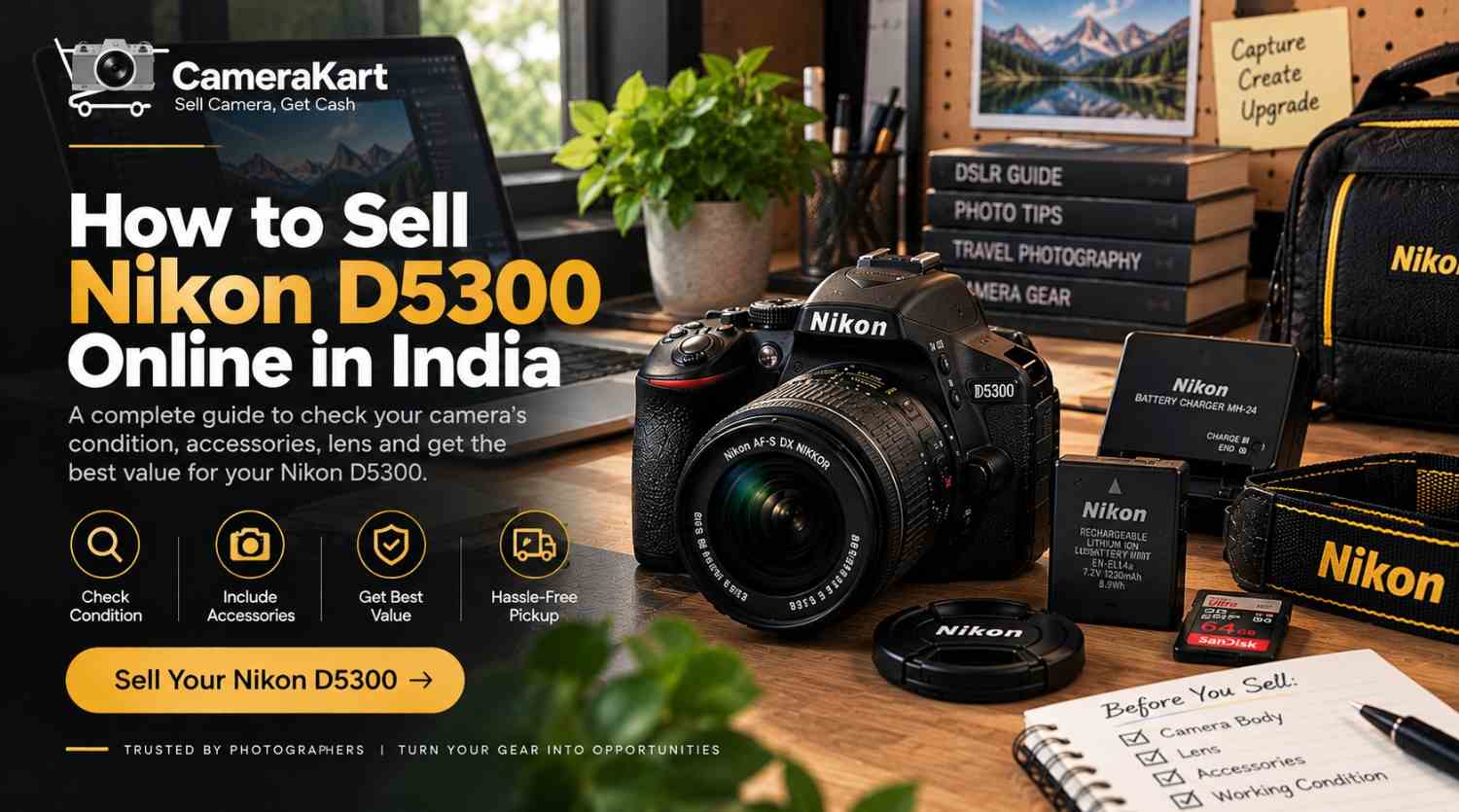
    Before checking the camera, identify your complete D5300 setup.

    You may have:

    • Nikon D5300 body
    • NIKKOR lens
    • Battery
    • Battery charger
    • Camera strap
    • Body cap
    • Lens caps
    • SD card
    • Original box
    • Purchase invoice
    • Additional battery
    • Camera bag or other accessories

    The D5300 uses the Nikon F bayonet mount, and Nikon lists autofocus compatibility with AF-S and AF-I CPU lenses.

    This is important because a Nikon D5300 body and a Nikon D5300 with a lens and accessories are different packages.

    Before you request an evaluation, make a simple list of everything you intend to include.

    Check the D5300 Body for Real-World Wear

    Older DSLRs often show signs of regular use around the grip, buttons and bottom plate.

    Instead of only checking whether the camera “looks good,” inspect it section by section.

    Check the top

    Look at:

    • Mode dial
    • Shutter button
    • Command dial
    • Hot shoe
    • Flash area

    Check the front

    Inspect:

    • Lens mount
    • Grip
    • Mounting area
    • Built-in flash
    • Body surface

    Check the rear

    Look at:

    • LCD
    • Buttons
    • Navigation controls
    • Battery/card access areas

    Check the bottom

    Inspect:

    • Tripod socket
    • Battery compartment
    • Scratches or dents

    Normal marks from photography are different from cracks, impact damage or malfunctioning controls.

    When you sell used Nikon D5300, describe the condition honestly rather than trying to make an older camera appear unused.

    Test the 24.2MP Sensor

    The D5300 features a 24.2-megapixel DX-format CMOS sensor and Nikon’s specifications include an image-sensor cleaning system.

    You can perform a simple image test before selling.

    Mount a clean lens and photograph a plain, evenly lit surface using a smaller aperture. Then zoom into the image.

    Look for:

    • Persistent dark spots
    • Unusual lines
    • Abnormal marks
    • Consistent image defects

    If you notice a few dust spots, don’t immediately assume the sensor is damaged. Dust can sometimes be addressed through appropriate cleaning.

    Avoid touching the sensor directly.

    Check the Shutter and Shooting History

    The D5300 can shoot at up to 5 frames per second in continuous high-speed mode.

    If you’ve used the camera extensively, keeping the available shutter-count information ready can be useful when you’re preparing to sell it.

    However, shutter count should not be considered in isolation.

    Also consider:

    • Body condition
    • Sensor condition
    • Lens condition
    • LCD condition
    • Battery health
    • Buttons and dials
    • Previous repairs
    • Included accessories

    A camera’s overall condition gives a more complete picture than one number.

    Give the Vari-Angle LCD a Proper Test

    One of the useful features of the D5300 is its 3.2-inch vari-angle LCD monitor with approximately 1.037 million dots.

    Because the screen moves and is frequently handled, inspect it carefully.

    Test:

    • Screen brightness
    • Touch-free button navigation
    • Live View
    • Image playback
    • Menu display
    • Screen rotation/movement
    • Scratches or cracks
    • Unusual lines or flickering

    Move the vari-angle display gently through its normal range.

    If the screen works correctly but has ordinary cosmetic marks, mention those separately rather than treating them as a functional problem.

    Check the 39-Point Autofocus System

    The Nikon D5300 uses Nikon’s Multi-CAM 4800DX autofocus module with 39 selectable focus points, including dynamic-area and 3D-tracking modes.

    Before you sell Nikon D5300 online, test autofocus in normal shooting situations.

    Try:

    Single-point AF:
    Focus on a stationary object.

    Dynamic-area AF:
    Try a subject that moves slightly.

    Continuous AF:
    Track a moving subject.

    Live View AF:
    Test focusing through the LCD.

    You don’t need to test every setting. The goal is to identify whether the autofocus system behaves normally.

    Inspect Your NIKKOR Lens Separately

    If you’re selling the camera with a lens, don’t stop after inspecting the camera body.

    The lens should receive its own check.

    Front glass

    Look for:

    • Scratches
    • Cracks
    • Fungus
    • Heavy dust

    Rear glass

    Check the rear element and mount.

    Focus ring

    Rotate it and look for unusual stiffness or looseness.

    Zoom ring

    If you’re using a zoom lens, test the complete zoom range.

    Autofocus

    Mount the lens and take several photographs at different distances.

    Mount

    Check that the lens attaches and detaches normally.

    If your package contains more than one lens, list each lens separately.

    Test the Built-In Flash

    The D5300 has a built-in flash with TTL/i-TTL flash control.

    It’s easy to forget about the flash when preparing an older DSLR.

    Simply pop it up and take a test photograph.

    Check that:

    • The flash opens properly
    • It fires
    • The camera records the image normally
    • It closes properly

    If you have never used the flash, this is a good time to check it.

    Record a Short Full HD Video

    The D5300 supports Full HD 1920×1080 video recording up to 60 fps, depending on the selected setting.

    You don’t need to record a long video.

    Make a short test clip and check:

    • Recording starts normally
    • File saves correctly
    • Playback works
    • Audio is recorded
    • Autofocus behaves as expected
    • Memory card performs normally

    The D5300 also includes a built-in microphone and support for an external stereo microphone.

    If you own an external microphone and are including it in the package, mention it separately.

    Check Wi-Fi and GPS

    One feature that makes the D5300 different from some older entry-level DSLRs is its built-in connectivity.

    Nikon lists built-in Wi-Fi and built-in GPS on the D5300.

    If these features are important to your setup, test them before selling.

    Nikon’s documentation explains that the D5300 can connect to a compatible smartphone through its built-in Wi-Fi using Nikon’s Wireless Mobile Utility workflow.

    You don’t need to spend a lot of time configuring the connection. Just check the relevant functionality if you regularly use it.

    Before handing over the camera, remove your personal wireless connections and reset relevant settings.

    Check the SD Card Slot

    The D5300 uses SD, SDHC and SDXC memory cards and has one SD card slot.

    Test it by:

    1. Inserting a compatible card.
    2. Taking several photographs.
    3. Recording a short video.
    4. Reviewing the files.
    5. Confirming the files save correctly.

    Then remove your personal card.

    If you’re including an SD card with the camera, mention its capacity separately.

    Battery and Charger Matter Too

    The D5300 uses an EN-EL14a rechargeable Li-ion battery, and Nikon lists the MH-24 quick charger as a compatible charger.

    Before you sell my Nikon D5300, check:

    • Battery charging
    • Battery condition
    • Charger operation
    • Battery compartment
    • Any visible battery damage

    If you have an extra battery, charger or compatible accessory, add it to your package list.

    Keep Your Original Documents If Available

    Clean the Camera Before Selling

    A basic external cleanup can make your equipment easier to inspect.

    Use an appropriate microfiber cloth to gently clean:

    • Camera exterior
    • LCD surface
    • Lens exterior
    • Lens caps
    • Camera strap
    • Camera bag

    Remove dust from the exterior without attempting complicated repairs.

    The purpose isn’t to hide wear. It’s simply to present the camera in a clean, organized condition.

    Should You Sell the D5300 Body or Complete Kit?

    This depends on what equipment you still want to keep.

    Sell the body only

    If you want to retain your compatible NIKKOR lens for another Nikon DSLR, selling only the D5300 body may be suitable.

    Sell camera + lens

    If the lens is also no longer needed, selling them together can create a more complete package.

    Sell the complete DSLR setup

    If you’re moving completely away from the Nikon F-mount system, you may also have additional lenses, batteries and accessories that you no longer use.

    Before deciding, separate the equipment you want to keep from the equipment you actually want to sell.

    If you still have the original invoice, box or purchase-related documents, keep them ready.

    You should also have the camera’s serial number available if verification requires it.

    Before handing over your D5300:

    • Back up photographs
    • Remove your SD card
    • Disconnect your smartphone
    • Remove personal wireless settings
    • Reset the camera where appropriate

    This is particularly useful because the D5300 has built-in Wi-Fi and GPS functionality.

    Why You Might Decide to Sell Your Nikon D5300

    There are several practical reasons to consider selling an older DSLR.

    You’re moving to mirrorless

    If your primary camera has changed to a mirrorless system, the D5300 may no longer fit your current workflow.

    You have upgraded

    A newer camera may have become your primary body while the D5300 remains unused.

    You don’t shoot regularly anymore

    If the camera spends most of its time stored in a bag, you may decide to sell rather than leave it unused.

    You want to simplify your equipment

    Photographers sometimes accumulate bodies, lenses and accessories over time. Selling unused equipment can simplify the kit you actually use.

    How to Sell Nikon D5300 Online With CameraKart

    Once you’ve inspected the camera, lens and accessories, the next step is to provide accurate model and condition details.

    When you sell Nikon D5300 online, keep the following information ready:

    • Camera model
    • Body condition
    • Shutter information, if available
    • Lens model
    • Accessories
    • Battery condition
    • Known issues
    • Whether the original box or invoice is available

    CameraKart has a dedicated Nikon D5300 selling page where you can start the selling process.

    CameraKart’s current DSLR-selling information describes a process involving camera details, an offer/evaluation, pickup or drop options and payment after verification.

    Nikon D5300 Seller Checklist

    Before submitting your camera, use this quick checklist:

    Camera Body

    ☐ Body inspected
    ☐ Buttons tested
    ☐ Dials tested
    ☐ Ports checked
    ☐ Lens mount checked
    ☐ Shutter tested

    Image & Focus

    ☐ Sensor checked
    ☐ Autofocus tested
    ☐ Live View tested
    ☐ Optical viewfinder checked
    ☐ Built-in flash tested

    Screen & Video

    ☐ LCD tested
    ☐ Vari-angle movement checked
    ☐ Video recording tested
    ☐ Audio checked

    Connectivity

    ☐ Wi-Fi checked if used
    ☐ GPS checked if used
    ☐ Personal connections removed

    Accessories

    ☐ Battery
    ☐ Charger
    ☐ Body cap
    ☐ Lens
    ☐ Lens caps
    ☐ Strap
    ☐ SD card, if included
    ☐ Box/invoice, if available

    Before Handover

    ☐ Photos backed up
    ☐ SD card removed
    ☐ Personal settings reviewed
    ☐ Camera reset where appropriate

    Final Thoughts

    If you’re planning to sell Nikon D5300 online in India, preparation is more useful than simply looking at the camera’s age.

    Check the 24.2MP DX sensor, 39-point autofocus, shutter, vari-angle LCD, optical viewfinder, lens, built-in flash, Full HD video, Wi-Fi, GPS, battery and SD card functionality before submitting the camera for evaluation. These features are documented in Nikon’s D5300 specifications.

    Once you’ve separated the equipment you want to sell, tested the camera and collected the relevant accessories, you can visit the Sell Nikon D5300 page on CameraKart and provide your camera details.
  • How to Sell Nikon D5600 Online in India: A Practical Guide Before You Sell

    How to Sell Nikon D5600 Online in India: A Practical Guide Before You Sell

    If you own a Nikon D5600 and are planning to sell it, don’t judge the camera only by its age or outer appearance. For a used DSLR, the condition of the body, shutter, sensor, autofocus, LCD, lens, battery and included accessories can all be relevant when the camera is evaluated.

    The Nikon D5600 is a DX-format DSLR with a 24.2MP sensor, Nikon F mount, 39-point autofocus system, 5 fps continuous shooting, a 3.2-inch vari-angle touchscreen and Full HD video recording up to 60 fps. It also supports SnapBridge connectivity through Bluetooth/Wi-Fi.

    If your D5600 is no longer your primary camera, you’re upgrading, or you simply have unused equipment, this guide will help you prepare it before you sell Nikon D5600 online.

    You can also check the dedicated Nikon D5600 selling page on CameraKart.

    Start With Your Nikon D5600 Kit

    Before you decide how to sell your camera, first identify exactly what you have.

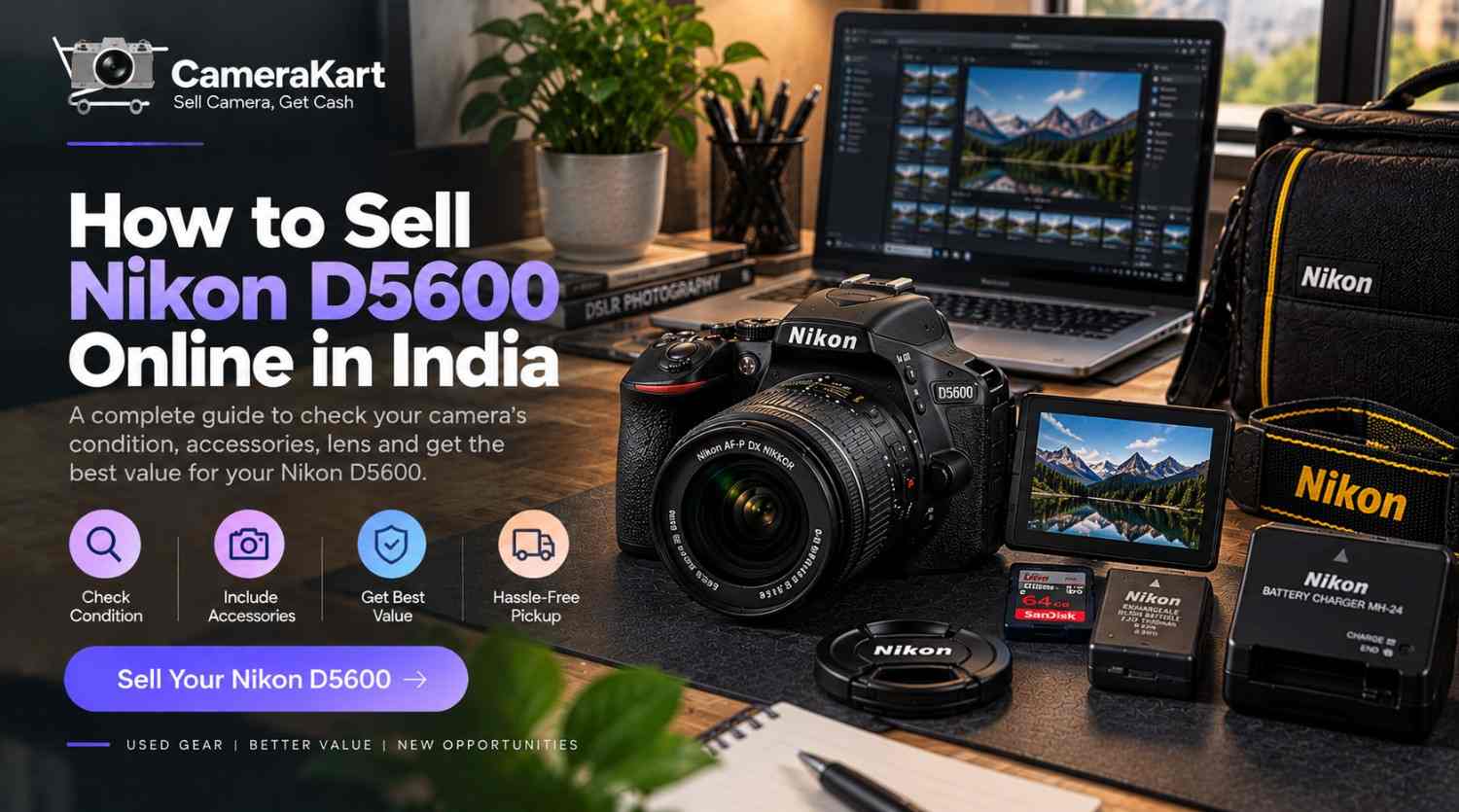
    Your setup could contain:

    • Nikon D5600 body
    • NIKKOR lens
    • Battery
    • Battery charger
    • Camera strap
    • Body cap
    • Front/rear lens caps
    • Memory card
    • Original box
    • Purchase invoice
    • Additional accessories

    The D5600 uses the Nikon F bayonet mount and supports autofocus with compatible AF-S, AF-P and AF-I lenses.

    So if you’re selling the camera together with a lens, inspect both separately instead of treating them as one item.

    Check the Body From Top to Bottom

    Before you sell used Nikon D5600, give the camera a proper physical inspection.

    Pay attention to areas that receive frequent handling:

    • Camera grip
    • Mode dial
    • Command dial
    • Shutter button
    • Battery compartment
    • SD-card compartment
    • Tripod socket
    • Hot shoe
    • USB port
    • HDMI port
    • Lens mount
    • LCD screen

    Look for scratches, dents, cracks, loose covers or signs of impact.

    Normal cosmetic wear from regular photography is different from functional damage. If there is a known issue, it’s better to mention it accurately during the selling process.

    Check the Shutter and Shooting History

    For a DSLR such as the D5600, shutter usage is useful information to keep ready.

    The D5600 supports continuous shooting at up to 5 frames per second under specified settings.

    If you know the camera’s shutter count, keep that information available when you request an evaluation.

    But don’t judge the entire camera only by shutter count.

    Also consider:

    • Overall body condition
    • Sensor condition
    • Lens condition
    • Buttons and dials
    • LCD
    • Battery
    • Previous maintenance
    • Accessories

    Two cameras with similar shutter counts can still be in very different physical conditions.

    Inspect the Sensor Before Selling

    The D5600 has a 24.2MP DX-format sensor and Nikon’s specifications include an image-sensor cleaning system.

    For a basic inspection, use a clean lens and photograph a plain, evenly lit surface.

    Then zoom into the image and look for persistent spots or unusual marks.

    If you see dust spots, don’t automatically assume that the sensor has a serious problem. Sensor dust can sometimes be addressed through proper professional cleaning.

    Avoid touching the sensor directly.

    Give the NIKKOR Lens Its Own Inspection

    If you’re selling your D5600 with a lens, the lens can make up an important part of the complete kit

    Check:

    Front element

    Look for scratches, cracks, fungus or heavy marks.

    Rear element

    Inspect the rear glass and mount.

    Focus ring

    Rotate it and check for unusual resistance.

    Zoom ring

    If you’re using a zoom lens, make sure the movement is smooth.

    Autofocus

    Test autofocus through the camera.

    Lens mount

    Check for visible damage or excessive wear.

    Also identify the exact lens model you’re including.

    Instead of writing:

    Nikon camera with lens

    write something more specific such as:

    Nikon D5600 + NIKKOR 18-55mm lens

    That makes the equipment package much clearer.

    Test the 39-Point Autofocus System

    The D5600 uses Nikon’s Multi-CAM 4800 autofocus sensor module with 39 autofocus points, including 3D tracking.

    Before you sell Nikon D5600 online, test autofocus in a few simple situations.

    Stationary subject

    Focus on an object at different distances.

    Moving subject

    Try continuous autofocus on a moving object.

    3D tracking

    Test subject tracking where appropriate.

    Live View

    Switch to Live View and check focusing there as well.

    You’re not trying to perform a laboratory test. The purpose is simply to identify whether the camera’s basic focusing functions are working normally.

    Test the Vari-Angle Touchscreen

    The D5600 has a 3.2-inch vari-angle touchscreen LCD with approximately 1.037 million dots.

    This is one area that should be checked carefully because the screen is frequently moved and touched.

    Check:

    • Touch response
    • Screen brightness
    • Display quality
    • Dead pixels
    • Scratches
    • Hinged movement
    • Live View
    • Playback
    • Menu navigation

    Move the screen gently through its normal range and make sure there is no unusual looseness or damage.

    Check the Optical Viewfinder

    Unlike a mirrorless camera, the D5600 uses an optical DSLR viewfinder.

    Look through it and check:

    • Viewfinder clarity
    • Eyepiece condition
    • Diopter adjustment
    • Dust or unusual marks
    • Autofocus indicators
    • Information display

    The camera’s optical viewfinder has approximately 95% frame coverage horizontally and vertically according to Nikon’s specifications.

    Test the Built-In Flash

    The D5600 has a built-in flash with TTL/i-TTL flash control.

    Pop the flash up and take a test photograph.

    Check that:

    • Flash opens properly
    • Flash fires
    • Exposure behaves normally
    • Flash closes properly

    If you rarely use the flash, it’s easy to forget about it when preparing an older DSLR for sale.

    Record a Short Full HD Video

    The D5600 supports Full HD 1920×1080 recording up to 60 fps, depending on the selected settings.

    Record a short clip and check:

    • Video starts normally
    • Recording continues normally
    • Autofocus behaves as expected
    • Audio is recorded
    • File saves correctly
    • Playback works

    You don’t need to test every frame-rate option.

    A short practical test is enough to identify obvious problems.

    Check the SD Card Slot

    The D5600 uses SD, SDHC and SDXC cards and has one SD card slot.

    Insert a compatible card and:

    1. Take a photograph.
    2. Record a short video.
    3. Review the files.
    4. Confirm the files are saved correctly.
    5. Remove your personal card after testing.

    If you’re including a memory card with the camera, mention its capacity separately.

    Check the Battery and Charger

    The D5600 uses an EN-EL14a rechargeable Li-ion battery, with the Nikon MH-24 quick charger listed as compatible with the camera.

    Check:

    • Battery charges normally
    • Battery holds charge
    • Battery compartment is clean
    • Charger works
    • No physical battery damage

    If you have an extra compatible battery, include it in your equipment list.

    Don’t Forget SnapBridge and Wireless Connectivity

    The D5600 supports SnapBridge, Bluetooth and Wi-Fi connectivity.

    If wireless connectivity is important to you, test it before selling.

    You don’t need to spend a lot of time configuring your phone. Just confirm that the relevant connectivity functions behave normally.

    And before handing over the camera, remove your personal device connection and reset the camera settings where appropriate.

    What Accessories Should You Include?

    Before you sell my Nikon D5600, collect everything that belongs to the camera.

    ItemCheck
    D5600 bodyOverall condition
    BatteryCharging/condition
    ChargerWorking
    LensGlass + autofocus
    Body capAvailable
    Lens capsAvailable
    Camera strapCondition
    SD cardIf included
    Original boxIf available
    InvoiceIf available

    Nikon’s listed D5600 accessories include the EN-EL14a battery and MH-24 charger, while exact kit contents can vary depending on the original package.

    Body Only or D5600 With Lens?

    One important decision is what exactly you want to sell.

    D5600 body only

    This can make sense if you want to keep your NIKKOR lenses for another compatible Nikon camera.

    D5600 + one lens

    This creates a more complete package for someone looking for a camera-and-lens setup.

    Complete D5600 kit

    If you’re leaving DSLR photography or moving to another camera system, you may also have additional lenses or accessories that you no longer need.

    The choice depends on which equipment you want to keep.

    Clean It — But Don’t Overdo It

    A basic cleaning before selling is useful.

    You can:

    • Wipe the exterior with an appropriate microfiber cloth
    • Remove dust from the body
    • Clean the lens exterior carefully
    • Clean the LCD gently
    • Remove dust from the camera bag
    • Organize the accessories

    Avoid aggressive cleaning methods or attempting repairs yourself.

    The goal is to present the camera in its existing condition, not to make it appear different from what it actually is.

    Keep Your Purchase Documents

    If you still have the original invoice, box or other purchase documents, keep them together.

    Also keep the camera’s serial number available when required.

    Before handing over the camera:

    • Back up your photographs
    • Remove your SD card
    • Disconnect personal devices
    • Review wireless settings
    • Reset personal settings where appropriate

    This is especially relevant for a camera that has been connected to your smartphone through SnapBridge.

    Why Are You Selling Your Nikon D5600?

    The reason you’re selling can help you decide what equipment to include.

    Upgrading your camera

    You may have moved to a newer DSLR or mirrorless camera.

    Moving to mirrorless

    If you’re changing systems, you may decide to sell the D5600 along with compatible DSLR lenses.

    Camera is not being used

    If the camera spends most of its time stored away, you may prefer to evaluate its selling option.

    Changing your photography requirements

    Your current work may require different equipment than when you purchased the D5600.

    How to Sell Nikon D5600 Online With CameraKart

    Once you’ve checked your camera and collected the relevant accessories, you can submit the model and condition details for evaluation.

    When you sell Nikon D5600 online, provide accurate information about:

    • Body condition
    • Shutter count, if available
    • Lens included
    • Accessories
    • Battery condition
    • Working condition
    • Any known issues

    CameraKart has a dedicated sell Nikon D5600 online  page where you can start the process.

    CameraKart’s current camera-selling workflow describes model selection, an offer/evaluation, pickup scheduling and payment after inspection.

    Nikon D5600 Seller Checklist

    Before submitting your camera, save this checklist:

    Camera Body

     ☐ Body inspected
    ☐ Buttons tested
    ☐ Dials tested
    ☐ Ports checked
    ☐ Lens mount checked
    ☐ Shutter tested

    Performance

     ☐ Sensor checked
    ☐ Autofocus tested
    ☐ Live View tested
    ☐ Built-in flash tested
    ☐ Video tested
    ☐ SD card tested

    Display

     ☐ LCD tested
    ☐ Touchscreen tested
    ☐ Vari-angle movement checked
    ☐ Optical viewfinder checked

    Accessories

    ☐ Battery
    ☐ Charger
    ☐ Body cap
    ☐ Lens
    ☐ Lens caps
    ☐ Strap
    ☐ Box/documents

    Before Handover

     ☐ Photos backed up
    ☐ SD card removed
    ☐ Personal connections removed
    ☐ Settings reviewed/reset

    Final Thoughts

    If you’re planning to sell Nikon D5600 online in India, start by understanding the actual condition of your complete setup rather than focusing only on the camera’s age.

    Check the 24.2MP DX sensor, 39-point autofocus system, shutter, LCD, optical viewfinder, built-in flash, lens, battery and SD card functionality before submitting the camera for evaluation. These are documented D5600 specifications from Nikon.

    Once you’ve checked the equipment and gathered your accessories, you can visit the Sell Nikon D5600 page on CameraKart and provide your camera details.
  • Sell Used Camera in Bangalore: How to Get a Fair Price and Fast Pickup

    Sell Used Camera in Bangalore: How to Get a Fair Price and Fast Pickup

    If you own an old DSLR or mirrorless camera action camera or video camera that is in a closet, selling it could be a viable option to restore some value. For filmmakers, photographers, hobbyists and content creators living in Bangalore The challenge isn’t always finding a buyer interested in cameras. The challenge is finding a method to offer the ssssssequipment for sale at a fair price, without wasting weeks in negotiations.

    If you’re looking to sell used camera in Bangalore, sell old camera in Bangalore, or sell camera online in Bangalore the initial step should be to comprehend what factors determine the resale value of your camera and how the process of selling is carried out.

    Why Sell Your Used Camera in Bangalore?

    Bangalore is home to a huge community of filmmakers, photographers as well as wedding professionals, content creators as well as students and photography enthusiast. Many of them frequently upgrade their equipment or change between camera systems to another.

    This means that a camera older than isn’t necessarily useless just because you’ve put it away.

    You might want you to market your camera for:

    • The model you upgraded was better model
    • You’re changing from a DSLR to mirrorless
    • You’ve changed between brands to the next
    • The camera is no longer used regularly. camera frequently
    • You may have spare camera bodies or lenses.
    • You require funds to purchase new equipment for photography.
    • The camera has been unattended for a long period of time

    Instead of storing your equipment in storage until its value fluctuates, it is possible to have it analyzed and decide if selling is the right choice.

    What Cameras Can You Sell in Bangalore?

    The resale market has various types of photographic equipment. Depending on the buyer as well as model, you might be selling:

    DSLR Cameras

    The older Canon, Nikon, Sony and various DSLR models may still be in the need for resales, especially if cameras are in good condition.

    The most searched-for seller terms are:

    • Sell Canon DSLR in Bangalore
    • Sell Nikon DSLR in Bangalore
    • Sell Sony DSLR in Bangalore
    • Sell old DSLR camera in Bangalore
    • Sell used DSLR camera online

    Mirrorless Cameras

    Mirrorless cameras are extensively used among photographers, Vloggers, and content creators. If you’ve upgraded your camera to a more modern model the camera you had before could still be resaleable.

    It is possible to sell models from brands like Sony, Canon, Nikon and Fujifilm depending on the model and buyer’s requirements.

    Action and Video Cameras

    GoPro Compact action cameras, and professional video cameras may also be analyzed for resales. Condition and battery health, as well as recording quality and accessories are crucial when it comes to these cameras.

    Camera Lenses

    There is no requirement you sell the lens and camera in tandem. The lens that is compatible can be sold separately depending on the design, mount, and the market demand.

    What Determines Your Camera’s Resale Value?

    There isn’t a single pricing for resales which applies to each camera. Two cameras of the same model may have different prices due to their use and condition. could be different.

    The primary factors are:

    1. Exact Camera Model

    The model is among the most important aspects a buyer should be aware of.

    Saying that you own the “Sony camera” is not enough. The specific model, such as Sony A6400, Sony A6600 or Sony A7C can be a major factor in evaluating the quality of the equipment.

    2. Physical Condition

    Check the body for

    • Scratches
    • Dents
    • Cracks
    • Worn rubber grips
    • Broken buttons
    • Screen marks
    • Loose ports
    • Lens mount damage

    The normal signs of wear and tear do not necessarily make cameras unmarketable. The most important thing is whether the wear is affecting functionality or the overall condition.

    3. Shutter Count

    For a variety of DSLR or mirrorless models the shutter count can provide useful information on how they are used.

    A lower shutter count may increase buyer confidence, however it shouldn’t be considered as a whole. The overall condition of the camera, performance, demand for models and history of maintenance are all important.

    4. Sensor and Image Quality

    Cameras may appear good from the outside, but they could be plagued by issues that impact the quality of images.

    Before selling, verify that the camera is capable of producing normal pictures and if there are any issues visible in the camera’s sensor display, autofocus, or other essential functions.

    5. Lens Condition

    If you’re selling a camera that has lenses that are lenses, it could affect the value of the camera.

    Make sure to check for:

    • Fungus
    • Haze
    • Scratches
    • Excessive dust
    • Autofocus problems
    • Zoom and focus-ring problems
    • Mount damaged

    A well-maintained, clean lens can make an entire camera kit look more attractive.

    6. Battery and Charger

    The original charger and battery are great accessories to have when you have these items.

    If there is anything missing you can be sure to mention it in the valuation process, rather than concealing it.

    7. Box, Bill and Other Accessories

    An original packaging box and purchase receipt and warranty documentation, as well as the lens caps, camera straps and other accessories can be used to determine the completeness and history of your camera equipment.

    But, the absence of packaging doesn’t mean the camera is not worth reselling. The exact    impact is contingent on the model and the buyer’s confirmation procedure.

    How to Prepare Your Camera Before Selling

    A little planning will make selling easier.

    Clean the Camera Carefully

    Get rid of fingerprints, dust and dirt from the lens and body.

    Do not use unsuitable household cleaners on the cameras or lenses.

    Check All Major Functions

    Before you ask for a valuation be sure to

    • Power on/off
    • Shutter operation
    • Autofocus
    • Manual focus
    • LCD display
    • Viewfinder
    • Dials and buttons
    • Memory slot for cards
    • Battery
    • Charging
    • Ports for USB/HDMI where appropriate

    If you discover a fault make sure you mention it clearly.

    Find Your Shutter Count

    If your camera has information on shutter count, make sure you have it up to date. This can give more information about the camera’s performance.

    Collect Your Accessories

    Gather everything you own:

    • Battery
    • Charger
    • Strap
    • Body cap
    • Lens cap
    • Lens hood
    • Original box
    • Purchase bill
    • Warranty card
    • Camera bag
    • Other compatible products

    There is no need to wait until you’ve all the original items before requesting a valuation.

    Should You Sell Your Camera Online or to a Local Buyer in Bangalore?

    Both are available, however they are different in terms of experience.

    For an individual buyer You may be required to:

    • Create listings
    • Respond to messages that are repeated
    • Discuss prices
    • Arrange meetings
    • Perform a self-inspection
    • Confirm payment
    • Control the handover

    A professional service for buying cameras can make the process simpler by handling appraisal of the camera, inspections, and pickup payment with a well-organized process.

    For sellers who appreciate ease of use, this is especially beneficial when selling a high-end DSLR or mirrorless camera, or professional lens.

    How to Sell Your Used Camera to CameraKart

    CameraKart’s sales process is built around obtaining a quote before arranging pickup, and then completing the payment following an inspection. The site currently displays the procedure as an immediate offer, free delivery to your doorstep, inspection and payment.

    The fundamental process is:

    Step 1: Select Your Camera

    Find the model of your camera on CameraKart and begin your selling procedure.

    Step 2: Provide Accurate Details

    Input information regarding the condition of your camera, its use and other accessories.

    Step 3: Get Your Estimated Value

    The initial value is a rough estimation. The final amount is contingent on the details provided and the actual condition observed at the time of inspection.

    Step 4: Schedule Pickup

    If the appropriate pickup service is available in your Bangalore area, plan your pickup according to the procedure in place.

    Step 5: Camera Inspection

    The equipment is tested against the information that is provided.

    Step 6: Complete the Payment

    After inspection and verification After verification and inspection, the process of payment is completed in accordance with the terms of agreement.

    How to Get a Better Value for Your Camera 

    It is impossible to control every aspect that influences resale value but you can limit unneeded reductions.

    Before selling:

    1. Clean the camera.
    2. Give the exact model number.
    3. Please share the shutter count if there is.
    4. Include any repair or damage record.
    5. Include any original accessories you have.
    6. Keep the lens and body in one piece if you’re making them available as a set.
    7. Don’t conceal functional issues.
    8. Have the camera evaluated prior to investing in costly repairs.

    Importantly, don’t evaluate the value of your camera solely by the original price of purchase. Value of used cameras is contingent upon demand, the type, condition, and the equipment included.

    Popular Camera Brands You Can Sell in Bangalore

    Camera manufacturers typically look for specific services that are brand-specific, such as:

    • Sell Sony camera in Bangalore
    • Sell Canon camera in Bangalore
    • Buy Nikon camera to Bangalore
    • Offer to purchase Fujifilm camera to Bangalore
    • Buy DSLR camera to Bangalore
    • Sell a mirrorless camera for sale in Bangalore

    For an accurate estimate make sure you provide the exact camera model instead of just the model’s name.

    For instance, “Canon camera” gives only a few details, whereas “Canon EOS R6” or “Canon 200D Mark II” will identify the camera more precise.

    Ready to Sell Your Used Camera in Bangalore?

    With CameraKart it is possible to begin by choosing your camera model and then providing the details necessary to be able to evaluate it.

    Are you ready to market your DSLR? Get a camera valuation and begin selling it using CameraKart.

  • Sell DSLR Camera Online in India: A Practical Guide for Photographers Ready to Upgrade

    Sell DSLR Camera Online in India: A Practical Guide for Photographers Ready to Upgrade

    For many photographers who are photographers, DSLRs are for many photographers, DSLR will be much more than an item of equipment. It could be the camera through which they started their journey into photography, completed their first paid assignment, or recorded years of memories.

    Photography equipment isn’t in tune with your workflow forever.

    You might be upgrading to a more modern DSLR or switching to a mirrorless camera, or you have stopped using your older camera as frequently as you previously did. Your camera could be in your bag. However, if it’s not been used in a long time you should consider whether it is a good idea.

    This is when sell DSLR Camera can be a sensible alternative.

    Instead of keeping an unusable camera, look into its resale possibilities and determine if selling it will help you fund the next camera or lens upgrade.

    When Is It Actually a Good Time to Sell Your DSLR?

    There’s no age limit at the point that a DSLR quickly becomes suitable to sell. A camera that’s five years old can be useful, whereas the latest model may be obsolete if it no longer is a good fit for the user’s needs.

    The most reliable gauge is the way you use your camera in the present.

    If the camera you purchased is now your primary camera and you haven’t used the DSLR for a while It could be the right and ideal time to consider rethinking keeping it. It’s the same when your needs in photography have changed, and the previous camera doesn’t have what features and workflow that you require.

    However If you’re a professional photographer who requires a second body to shoot weddings, events or commercial shoots, having an extra DSLR to backup could still be worth it.

    The choice is based on actual use, not simply the age of your camera.

    Has Your Photography Setup Changed?

    Camera upgrades usually result in equipment that is not being used.

    A photographer could move from a basic DSLR to a more professional camera. A different person might change from a DSLR system to a mirrorless. In both instances the previous camera could slowly lose its importance.

    If you find yourself using a newer camera for every shot, while your older DSLR remains at home, the idea of selling the older camera is a sensible option.

    What Determines the Resale Value of a DSLR?

    If you sell DSLR Camera Online, the purchase price you originally paid is only a tiny portion of the photo.

    The specific model, the current demand, physical condition, functionality along with usage data all affect the way in which a used camera is rated. This is the reason why two DSLR cameras of the same manufacturer can be sold at different prices.

    A model that is popular and in good condition could keep attracting buyers even after it has become many years old. However, a camera that has significant wear or technical issues may be rated differently.

    Instead of trying to determine a price by comparing what you purchased, it is better to be aware of the present condition and significance of your specific camera.

    The Exact Camera Model Matters

    The model’s name is more information than just mentioning the model.

    For instance, stating that you have a Canon DSLR doesn’t tell a prospective buyer if the model you’re offering is the EOS 200D II or EOS 90D or a different model.

    The cameras come with different specifications, targets for users and places in the market.

    Before making an appointment for an evaluation, verify the exact model that is printed on the camera’s body, or on your purchase paperwork. The accuracy of the model data will allow you to evaluate the camera properly.

    Condition Is More Than Cosmetic Appearance

    A few scratches caused by normal usage don’t make a DSLR hard to market.

    What is important is the general state of the machinery.

    The camera needs to be examined for problems with the screen buttons, dials, the battery compartment, memory-card slot and various other functions. If the camera was damaged, dropped or has an issue that is technical, this information should be reported.

    Being honest about the state of your equipment is crucial because the condition of the equipment will ultimately decide its assessment.

    Does Shutter Count Matter When Selling a DSLR?

    It’s a common subject for DSLR users, and with reasons that are well-founded.

    It gives an indication of the extent to which a camera is used, especially when looking at DSLR models that were designed to work with different kinds of photography.

    But, the shutter count should not be considered a separate measurement of the camera’s value.

    A DSLR with a greater shutter count may remain in good functioning condition if it’s been maintained properly. A camera that has moderate usage may present some other functional or physical problems.

    If you are aware of how many shutters your camera has, sharing it when selling is a good idea. If you don’t have it however, it shouldn’t prevent anyone from seeking out information regarding selling your camera.

    The overall state of the camera’s equipment is more than just one number.

    What Should You Do With the Lens?

    Selling your DSLR does not necessarily mean that you need to sell the lens along with it.

    Take a look at what your existing camera setup is prior to making a choice.

    If you’ve switched to a different DSLR with the same lens mount you might wish to keep the original lens. Selling it with the older body will be a costly mistake if you require an additional compatible lens.

    However, if you’ve changed systems and your old lens has also been left unattended and you want to sell both of the pieces of equipment might be more sensible.

    This is especially true to photographers that have shifted from DSLR to mirrorless, and have decided to not use their old camera or lenses compatible with it.

    The most important thing is to know what you really want rather than reselling the entire camera bag because you’ve upgraded one aspect of your setup.

    Should You Repair Your DSLR Before Selling It?

    This is an important decision that’s to be taken with care.

    If your previous DSLR is experiencing an issue that is minor to technical. Your first thought is to fix it so that you can sell it for a more affordable price.

    However, the cost of repair might not always be justified.

    If the camera is not in demand or is costly, adding additional costs prior to selling might not increase the return on your investment enough to justify the cost of repair.

    It is better to assess the camera’s condition first. When you understand how the camera will likely be evaluated at the moment it is possible to determine whether repair is financially feasible.

    Similar principles apply to cosmetic damages. There is no need to shell out money to make older cameras look like a brand new model.

    What If You Don’t Have the Original Box or Invoice?

    Many photographers fret over this issue when they make the decision to sell used camera equipment.

    After a few years of ownership it is very likely it is possible that original packaging was taken away or even discarded. It is the same when it comes to manuals, invoices or even some of the accessories.

    It doesn’t mean you need to stop attempting to sell the camera.

    If you have the original box, invoice charger, battery strap or any other original accessories, list the items. If there is something missing just provide precise details of what’s available.

    Transparency is a lot more effective in comparison to trying making a dated camera appear as the complete retail bundle but it’s not.

    Why Selling an Unused DSLR Can Be Better Than Keeping It in Storage

    A camera you don’t utilize isn’t helping you with your photography.

    There are instances when using an earlier DSLR as a backup camera makes sense. However, if you already own another camera that is reliable and the older model has been unoccupied for a lengthy time, its value for you could have diminished considerably.

    Selling the equipment could give you the chance to put your money towards something that you actually require.

    It could be a brand new lens and lights, equipment for storage batteries, or even a portion of your budget for the next camera.

    In this sense selling a used DSLR isn’t always about disposing of the camera.

    It could be a part of improving your photography system to be more efficient.

    Why Selling Through a Camera-Focused Service Can Be More Convenient

    Selling expensive equipment for photography privately may be a lengthy process.

    You may have to develop catalogs, respond to questions or negotiate prices, schedule meetings, and work with buyers who may not be ready to buy.

    For those who are just looking to get rid of an unneeded DSLR the process could turn into a nightmare.

    A service geared towards cameras is the most relevant option since the equipment is viewed specifically as photography equipment.

    CameraKart lets camera owners upload information about their camera and then go through a specific selling procedure. This is a great option for anyone who wishes to sell camera online without wasting a lot of time searching for individual buyers.

    The most important thing is to give accurate information about your equipment to ensure that the assessment will be made based on the exact equipment you’re offering.

    How to Prepare Your DSLR Before Selling

    Before you send your camera for review it is important to take the time to assess its condition.

    The exterior should be cleaned regularly and ensure that all major functions are in place. Look up the exact model’s name and, if it’s available, take note of the shutter count. If you’re bringing an optical lens, determine its model and verify its physical and optical condition.

    Take the charger and battery and determine if you are in possession of the initial box, or an invoice.

    If you see scratches, dents or other technical issues, don’t try to cover them up. Clear photos can also aid in communicating the condition of your camera more precisely.

    This method doesn’t promise an offer in particular but it will help make the selling process more transparent and effective.

    Don’t Set Your Selling Price Based Only on the Original Purchase Price

    One of the biggest errors when selling used equipment for photography is to think about how much the camera was worth when it was brand new.

    The used market doesn’t function like this.

    A camera bought a while ago could have more modern alternatives that are available today. In the same way some older models are highly sought-after because they offer excellent performance for a less cost of entry.

    The original price you paid for your purchase is valuable as a historical basis but it shouldn’t serve as the sole basis to determine today’s price for selling.

    An evaluation of the present gives you a more accurate base.

    Ready to Sell Your DSLR Camera?

    If your DSLR has ceased to be used following an upgrade, there’s no reason to put it away in your cabinet for the rest of time.

    Begin by identifying the model and then examining the condition of the model. Consider whether you require the body, then decide whether the lens needs to be added, and then gather any accessories you may have.

    Make sure the equipment is evaluated.

    You may want to sell DSLR Camera online or offer the older Canon or Nikon DSLR, or simply get rid of your photography equipment that is not being used knowing the current worth of your equipment can assist you in making a more educated decision.

    CameraKart offers a specific way for those looking to sell their cameras and other equipment for photography. Instead of trying for weeks to find a buyer you can simply submit your equipment’s details and choose what you want to do following an assessment.

    Conclusion

    A dated DSLR does not automatically devalue since newer cameras have entered the market.

    When the camera’s in good condition and has an interest, it could offer a resale value. However, the most important thing to consider is whether or not the camera can be used within the photographic setup.

    If you’ve upgraded, changed to a different camera system, or just stopped using your DSLR, taking it to be evaluated can help you determine whether you should keep it.

    Before you sell DSLR camera equipment, you must know the conditions, model, and other accessories you have. Don’t make your decision based solely on the price you paid for it originally.

    If your camera is unutilized, finding out how much the value is today could be the first step to put that money towards the equipment you’ll actually require.

  • Selling Multiple Cameras Online? How Photographers Can Get More Value From Unused Gear

    Selling Multiple Cameras Online? How Photographers Can Get More Value From Unused Gear

    Photographers seldom stop with one camera.

    As time passes, a photographer might accumulate the primary camera, an additional as well as older DSLR equipment including lenses, mirrorless cameras and other accessories. The problem begins when the latest equipment replaces older equipment.

    A camera that was used on a regular basis could remain in the camera bag.

    If you own a number of cameras or other pieces of equipment that you don’t need, selling them separately to buyers who are not yours can be an extremely time-consuming task.

    This is the reason a professional method for sell camera online can make the whole process much easier.

    Instead of viewing each camera as an individual piece of equipment, you can examine the entire collection of equipment and determine what’s worth keeping, which should be disposed of and what can be converted into money.

    When Does a Camera Become “Unused Gear”?

    It doesn’t mean that it’s damaged or obsolete.

    A camera is considered to be unusable if:

    • You’ve upgraded to a higher-end model.
    • You bought a backup camera which is seldom used.
    • Your photography has evolved.
    • You went to DSLR mirrorless.
    • You no longer use a particular camera body.
    • You’ve got duplicate equipment.
    • A camera or lens has been sitting in storage for several months.

    This is especially prevalent among professional photographers who upgrade their equipment frequently.

    Five camera bodies don’t necessarily seem sensible if you use just two.

    Look at Your Camera Collection Before Selling Anything

    If you are deciding to sell used camera equipment, create an easy inventory.

    For each camera, make note:

    EquipmentModelConditionUsageKeep/Sell
    Camera 1Exact modelExcellentRegularKeep
    Camera 2Exact modelGoodRareSell
    Camera 3Exact modelGoodUnusedSell
    Camera 4Exact modelAverageBackupConsider

    This easy exercise will determine which camera equipment is gaining its place inside your bag of cameras.

    Don’t Judge Equipment Only by Its Age

    One of the most common mistakes photographers make is to think:

    “This camera is old, so it isn’t worth selling.”

    This isn’t necessarily the case.

    An older camera that is well-maintained may still attract buyers especially if the model has an image among students, beginners and hobby photographers as well as professionals seeking backup equipment.

    The best answer is:

    “Am I still using this camera, and is there still a market for it?”

    If you answer the first answer is not yes, then it might be worth obtaining a value instead of letting the machine sit idle.

    Separate the Equipment You Actually Need

    When you’re an experienced photographer don’t be a smuggler and rush to sell everything.

    Maintain equipment that serves an actual reason for being there.

    For instance:

    Keep

    • The camera’s primary body
    • Essential backup body
    • Commonly used lenses
    • The equipment you use regularly is special-purpose.

    Consider Selling

    • Duplicate camera bodies
    • Older backup equipment
    • Cameras replaced by models that are more modern
    • Equipment that hasn’t been used for quite a while
    • Accessories you no longer need

    This strategy lets you earn cash without having to purchase important equipment.

    Multiple Cameras Can Mean Multiple Depreciation Risks

    Digital camera technology changes quickly.

    A more modern model could make an older model less appealing to buyers, even though the older model continues to function perfectly.

    It’s the reason photographers shouldn’t automatically presume:

    “I’ll sell it next year.”

    If you are aware that you’ll never use a certain camera, waiting for an explanation may not help you.

    Selling equipment that is not being used but is still relevant on the market for used equipment can be a better option.

    What About Cameras With Different Conditions?

    Every camera you own may be of the exact state.

    It could be:

    • One camera that has very minimal usage.
    • One of the most frequently used professional bodies.
    • A camera that has cosmetic markings.
    • One camera that is missing accessories.

    Do not think of them to be “old cameras.”

    Every item has the potential to be resold in a different way.

    If you Sell My Camera online complete information about each piece of equipment will help the buyer assess each piece of equipment in a particular way.

    Don’t Forget the Lenses

    Photographers usually concentrate on their camera bodies and neglect lenses.

    If you’ve rearranged your devices or added new equipment you might also have lenses that don’t fit to the current configuration.

    Before selling your camera collection, check for:

    • Duplicate lenses
    • Old kit lenses
    • Lenses to be used with a discontinued system
    • Accessories you no longer use
    • Additional batteries and chargers

    Sometimes, the stuff in your kitchen cupboard could be worth more in a complete package for resale than you think.

    Should You Sell Everything Together?

    But not always.

    There are two options.

    Option 1: Sell Equipment Separately

    This could be a good idea if you have individual items of high value that are in high demand.

    For example, a top camera body as well as a top lens could each draw different types of buyers.

    Option 2: Sell Multiple Items Together

    This is more practical when you have a number of related pieces of equipment you no longer require.

    A photographer who is cleaning out an old camera by selling several parts together could reduce the time handling separate inquiries.

    The most suitable option is dependent on the quality of the equipment, its condition and the demand of buyers.

    A Simple Way to Decide What to Sell

    Test yourself with this three-question quiz for each camera:

    1. When did I last use it?

    If you’re unable to remember this, that’s a great signal.

    2. Do I have a different camera that can do the same function?

    If it is, then the older body could be ineffective.

    3. Selling it could help me in the purchase of equipment I really will

    If it is true, selling may be financially profitable.

    This transforms an emotional choice into a pragmatic one.

    What Can Increase Buyer Interest in Your Used Gear?

    Before you sell camera online, set up your equipment.

    Keep in touch:

    • Camera body
    • Battery
    • Charger
    • Body cap
    • Lens cap
    • Original accessories
    • Available documentation
    • Compatible lenses

    Give accurate details about the health condition.

    A customer shouldn’t expect new equipment to appear new. It’s important to know exactly what they’re looking at.

    Example: A Photographer Upgrading His Entire Setup

    Imagine a photographer that previously employed:

    • Canon DSLR body
    • Backup Canon DSLR
    • Two older lenses
    • Extra batteries
    • Original chargers

    When switching to a mirrorless technology, the photographer makes use of nothing but the original equipment.

    The storage of everything doesn’t add any value.

    Instead, photographers can find the equipment not needed anymore and research alternatives to sell used camera equipment.

    The funds recouped can be used to:

    • A brand new lens
    • Additional batteries
    • Lighting equipment
    • A camera upgrade
    • Other requirements for photography

    This is a more productive utilization of equipment that is not used.

    Why Professional Photographers Shouldn’t Delay the Decision

    There’s a distinction between:

    “I might need this someday.”

    and

    “I actually use this equipment.”

    Professional photographers typically keep their old cameras for backup. It’s perfectly normal when the backup is needed for a specific reason.

    However, if you already have backups of multiple bodies and one isn’t being used for an extended period of time, knowing the current resale price can assist you in making an informed choice.

    Where CameraKart Fits Into the Process

    If you’ve decided on the equipment you don’t need anymore, CameraKart provides a way to begin selling your equipment without the hassle of finding buyers on your own.

    You may provide your camera’s details to be evaluated and then move forward with the sale based on the camera’s condition and the offer that is applicable.

    Photographers who wish to sell my Camera Online or clear several pieces of cameras, it will be much easier than making separate listings and handling unrelated inquiries.

    Before You Sell: 10-Minute Equipment Audit

    Check this list:

    • Check out every camera body
    • Identify duplicate equipment
    • Find out which cameras you employ.
    • Separate old systems
    • Check available lenses
    • Find original accessories
    • Note visible damage
    • Check function
    • Photograph clear and crisp
    • Choose what you really would like to keep

    After you’ve finished this step, you’ll have a more precise idea of the equipment you’re able to sell.

    Conclusion

    Photographers usually have more money stored in the camera bag and in storage cabinets than they are aware of.

    Cameras that have not been used or duplicate equipment, old equipment and lenses may be a source of value that can be recovered in the event that they cease serving their function.

    Instead of storing your equipment for years, examine your collection and note the items you are using.

    If you’ve made the decision to sell camera online, making sure the equipment is organised first will help you sell it more easily and assist you in making better choices about what remains and what is sold.

    For photographers who have multiple unusable cameras, selling off unnecessary equipment isn’t just about clearing out space. It can also assist in turning the equipment that isn’t being used into money for the gear you really need.

  • Ready to Sell My Camera? Here What Buyers Want to Know First

    Ready to Sell My Camera? Here What Buyers Want to Know First

    The most frequent messages that camera buyers get is:

    “I want to sell my camera. How do I start?”

    The solution isn’t as simple as buying it from someone who is willing to purchase it.

    Professional buyers typically require some important information prior to estimating the value of your camera. Making sure you provide the proper information from the beginning will save time, cuts down on unnecessary subsequent questions, and can help to get a better deal.

    If you’re looking to Sell My Camera, this guide explains precisely what buyers will be looking for before they review your equipment.

    Your Camera Model Is the Starting Point

    Before negotiating price buyers should first know the exact model of camera.

    For instance:

    • Canon EOS 200D II
    • Sony A6400
    • Nikon D7500
    • Canon R50

    A majority of sellers will only use brands, however various models may have different resale prices.

    The correct model will help customers understand what they’re looking at.

    Be Honest About the Camera’s Condition

    A used camera can never be perfect.

    Professional buyers do not expect brand new equipment However, they do want exact information.

    Include things such as:

    • Cosmetic scratches
    • Lens condition
    • Button function
    • Battery health
    • Previous repairs

    Being transparent increases confidence and speeds up the assessment process.

    Accessories Can Make the Process Easier

    Before making contact with a buyer make sure you have everything you own.

    Accessories that are useful include:

    • Original battery
    • Charger
    • Camera strap
    • Lens caps
    • Original box
    • Purchase invoice

    Even if a few equipment is missing You can still sell used Camera equipment with success.

    Clear Photos Help Buyers Respond Faster

    Images of poor quality often cause delays in quotations.

    Take photos of:

    • The camera’s front
    • Rear LCD
    • Top controls
    • Lens mount
    • Accessories
    • Any visible cosmetic markings

    The photos are well lit and help buyers see the condition prior to inspecting.

    Buyers May Ask These Questions

    Before negotiating an offer, professionals often are able to ask questions, such as:

    QuestionWhy It Matters
    Does everything work properly?Confirms that the function is working
    Have you had the camera repaired?Helps evaluate condition
    Are original accessories available?Improves confidence of buyers
    What do you want to sell?Helps to understand the history of usage

    The ability to have these answers in hand makes the process easier.

    Avoid These Common Seller Mistakes

    A lot of first-time sellers do not realize they are creating delays through:

    • Sharing insufficient information.
    • Only sending one image.
    • Making guesses about the camera model.
    • Hiding known problems.
    • We’re waiting for several days to hear back.

    An honest and complete conversation generally leads to a quicker assessment.

    Selling Shouldn’t Feel Complicated

    Many think that selling a camera requires endless discussions or meeting a variety of buyers.

    A planned process is more efficient.

    When the information required is provided, buyers are able to evaluate the equipment in light of the condition, model, accessories and the current demand.

    How CameraKart Simplifies the Process

    CameraKart is designed for those who wish to Sell My Camera without the stress of creating multiple listings or having to negotiate with unidentified buyers.

    Instead of having to spend hours looking for buyers, request an expert evaluation and receive an offer that is fair and market-based.

    The process is easy, safe, secure, and accessible all over India.

    Conclusion

    Selling your camera becomes simpler if you have the proper information prior to asking for an estimate.

    Knowing the model of your camera by sharing clear pictures while revealing its condition with honesty and keeping the accessories you have together can help buyers assess the equipment more effectively.

    If you’re planning to Sell My Camera beginning with complete and accurate details is typically the fastest way to go from inquiry to sale.

  • Thinking of Upgrading? Sell Your Used Camera Before It Loses More Value

    Thinking of Upgrading? Sell Your Used Camera Before It Loses More Value

    Every year many photographers upgrade their cameras to the latest models. Many switch between DSLR to mirrorless cameras, and others are simply looking for higher autofocus, more advanced camera features or a higher resolution.

    However, there’s a mistake that many people make: they buy a new camera first, and then keep the old one in a cabinet for months.

    If you’re thinking of sell used camera equipment, delaying the decision could lower the value of resales over time. Knowing when to sell your camera can assist you in recovering more money and help make the upgrade cheaper.

    Why Waiting Can Reduce Your Camera’s Value

    In contrast to collectibles, the majority of digital cameras slowly decrease in value.

    With the introduction of new models to the scene, old models lose their appeal to prospective buyers. Even if the camera is in good condition, changes in the market can affect the price at which it is sold.

    Selling prior to an upgrade cycle usually gives the possibility of receiving a higher-quality offer.

    Upgrading Doesn’t Mean Your Old Camera Has No Value

    Many photographers believe that their camera isn’t worth a sale because it’s just a couple of years old.

    This isn’t always the case.

    The fad DSLR as well as mirrorless cameras continue to draw buyers from across India including those who are new to photography, hobbyists and students and content creators seeking inexpensive equipment.

    A camera that you don’t utilize could be of value to somebody else.

    Signs It’s the Right Time to Sell

    There’s no need to be patient until your camera gets old.

    Think about selling If:

    • You’ve made the decision to upgrade.
    • The camera you have is not used as often.
    • The most recent models of the model you own were recently released.
    • Your equipment is in good working order.
    • There is no need for an additional camera.

    Selling when demand is healthy can work to your advantage.

    Compare These Two Situations

    Seller ASeller B
    Sells before you buy a brand new cameraOne year is needed to upgrade after the upgrade.
    Good market demandLower buyer interest
    Better resale opportunityFurther depreciation
    It is easier to recover the investmentLower return

    Timing isn’t a guarantee of a better cost, however it does affect how attractive your camera appears in the marketplace for used cameras.

    Prepare Before You Sell

    Before you request an evaluation:

    • Clean the camera’s body.
    • Collect batteries, chargers, and any other items you need.
    • Verify that all functions are functioning.
    • Make clear and crisp photos.
    • Take note of the exact model and condition.

    These little steps will help make the process of evaluation faster and easier to understand.

    Don’t Let Your Camera Sit Unused

    Locking away expensive equipment seldom increases the value of equipment.

    Cameras that have not been used may show aesthetic wear, battery degrading or even become less attractive with the advent of new technology into the market.

    If you are certain that you’ll never ever use the camera again, selling earlier is typically an option.

    Why CameraKart Makes Upgrading Easier

    If you’re looking to sell used camera equipment prior to making the upgrade, CameraKart offers a simple method to start.

    Instead of searching for weeks for buyers who are interested in your camera, you can ask for an evaluation from a professional in light of the camera’s condition along with accessories and market demand.

    If you’re looking to upgrade to your first DSLR with mirrorless technology as well as replacing an old DSLR or DSLR, selling your current equipment could help pay for a portion of the expense.

    Conclusion

    It’s exciting to upgrade your camera but storing your old camera for too long could limit its resale value.

    If you’ve decided to upgrade to a more modern model, it often makes sense to sell used camera equipment when it’s popular.

    A well-maintained camera, if sold at the right moment, could aid in recouping additional value, and also make the next upgrade simpler.

  • Why Most People Get a Low Offer When They Sell Their Camera Online (And How to Avoid It)

    Why Most People Get a Low Offer When They Sell Their Camera Online (And How to Avoid It)

    You’ve probably seen it previously.

    Two individuals own nearly the exact same camera. One is offered a great deal and the other is dissatisfied with the purchase.

    Many sellers automatically assume that they are trying to bargain unfairly. In the real world, professional buyers assess more than just their camera’s model.

    If you’re looking to sell camera online, knowing the factors that influence the price can aid you in avoiding common errors and increase your chance of obtaining a better deal.

    Every Camera Is Evaluated Differently

    Professional buyers do not follow the fixed price list.

    Instead, each camera is analyzed according to its state of operation, its functionality and the current demand in the market.

    This is why the identical Canon, Sony, or Nikon model may receive various deals from different vendors.

    Knowing this process can help you establish realistic expectations prior to selling.

    Small Problems Often Lead to Bigger Price Reductions

    Most sellers are focused on the major issues, however buyers also pay attention to small things.

    Things include:

    • Grips made of rubber that have worn-out
    • Caps on the body are missing
    • Large scratches on the LCD
    • Lens fungus
    • Original battery that is not original
    • Button buttons that are loose

    Each of these concerns may appear to be minor, but they impact buyer confidence.

    Incomplete Information Delays the Selling Process

    One of the most common reasons sellers get lower bids is insufficient details.

    Instead of saying simply:

    “I would like to trade in my camera. “

    Include details like:

    • Exact model number
    • The age of the camera
    • Working condition
    • The included accessories
    • Repairs or issues

    The more precise your information is, the easier it will be for potential buyers to assess the camera in a fair manner.

    Timing Can Affect Your Offer

    A lot of users wait till they’ve purchased a new camera, before selling their old camera.

    In the future, more modern models might be on the market and will decrease the need on older machines.

    Making a sale at the right time usually results in higher value for resales.

    Presentation Matters More Than You Think

    Imagine purchasing two cameras that are identical.

    One arrives clean, and includes the Original charger and battery and all the accessories neatly packed.

    The other one is dirty with no accessories and includes poor-quality photographs.

    Which one would you put your trust in more?

    Professional buyers see things the same way.

    Comparison

    Seller ASeller B
    Clean CameraDusty Camera
    Complete AccessoriesMissing Charger
    Clear PhotosBlurry Images
    Accurate DetailsLimited Information
    Faster EvaluationDelayed Evaluation

    Small tweaks can lead to more smooth selling experiences.

    Common Reasons Buyers Reduce Their Offer

    Professional buyers typically lower their offers due to:

    • Accessories missing
    • Cosmetic damage
    • Functional issues
    • Previous repairs
    • Water damage
    • Lens fungus
    • Depreciation of the heavy market

    Knowing these things in advance can help sellers plan better.

    Expert Tip

    Before requesting a quotation:

    • Cleanse the camera
    • Charge the battery
    • Collect the accessories
    • Make sure you take clear photos
    • Discuss any issues truthfully

    These steps are simple to follow and help create an easier and more transparent process for evaluating.

    How CameraKart Helps

    A camera’s sale doesn’t need to be a multi-buyer transaction and endless negotiations or an uncertain price.

    With CameraKart you can request an evaluation by a professional using your camera’s current state and the market conditions.

    If you’re looking to sell used camera, Sell DSLR Camera or Sell camera online the process is created to be easy and transparent. It’s also accessible throughout India.

    Conclusion

    A low price does not mean that your camera’s worth is low.

    In most cases the final quote will depend on how the camera was displayed, the information it is shared as well as its general state of repair.

    If you’re looking to sell camera online and want to sell your camera online, following the necessary steps prior to asking for an evaluation will help you get the process done faster and ensure you get an acceptable market-based deal.

  • Why Two Identical Cameras Can Have Different Resale Prices

    Why Two Identical Cameras Can Have Different Resale Prices

    Imagine two photographers who decide to sell the exact same camera model within the same week. Both cameras were bought around the same time and both were utilized for personal photography. One owner is offered much more in comparison to the second.

    It’s a surprise to many sellers. However, it’s perfectly normal.

    The price of a camera’s resales cannot be determined solely on the model’s name. Professional buyers look at a range of variables before deciding on the value of the camera.

    If you’re looking to sell camera online Knowing these things will allow you to set reasonable expectations and increase your chances of obtaining an offer that is more favorable.

    The Model Is Only One Part of the Valuation

    Many consider that when two cameras are equipped with the identical serial number they must be able to receive the same price for resales.

    In real life the model is just the beginning point.

    Professional buyers must also think about:

    • Physical condition overall
    • Work performance
    • Lens condition
    • Accessories are included
    • Current demand
    • The age of the camera
    • Service History

    The reason is that two identical cameras may receive totally different quotes.

    Condition Makes a Bigger Difference Than Most People Think

    A camera that is maintained well will usually get an offer that is more attractive.

    Things that buyers are able to notice immediately include:

    • Scratches or dents
    • Rubber grip wear
    • LCD condition
    • Dust within the viewfinder
    • Lens fungus
    • Broken ports
    • The buttons are missing

    Even if a camera is working flawlessly, cosmetic flaws can affect the value of the camera.

    Complete Accessories Create More Confidence

    When a camera is delivered to buyers equipped with the original charger battery, box and manuals as well as lens cap, it indicates that the camera has been taken care of.

    Accessories might not significantly enhance the value however, they do make the package appear more appealing.

    A complete set can be simpler to appraise and sell.

    Usage History Also Matters

    Professional buyers are often asked the following questions:

    • Have you used the camera professionally?
    • Have you had it repaired previously?
    • Have you experienced water damage?
    • Are all functions functioning properly?

    A camera that is occasionally used for travel photography is typically different from the camera that is used for commercial shootings.

    Giving honest and accurate information can help buyers make an informed decision.

    Market Demand Changes Every Month

    The market for cameras is always growing.

    Certain older models continue to be successful because they are popular with beginners, whereas other models are not as popular once new models are released.

    The resale price is influenced by more than the condition of your camera, but also by buyers’ desire.

    Comparison Example

    Camera FeatureCamera ACamera B
    Physical ConditionExcellentAverage
    Original AccessoriesCompleteMissing Charger
    Lens ConditionCleanMinor Fungus
    Cosmetic WearMinimalNoticeable Scratches
    Estimated OfferHigherLower

    While both cameras use identical models, the final price can vary due to these reasons.

    Common Seller Mistakes

    A lot of people accidentally lower their camera’s value for resales through simple mistakes.

    Some examples include:

    • Cleansing the sensor in the wrong way
    • Losing original accessories
    • Too long in waiting to make a sale
    • Hiding defects
    • Incomplete details

    Making sure to avoid these mistakes will aid in ensuring that the evaluation process runs more efficiently.

    Expert Tip

    One of the simplest methods to enhance your selling skills is to set up your camera prior to making a request for the quote.

    Cleanse the camera exteriorally take all accessories in hand and charge the battery and take clear photos from a variety of perspectives.

    These little steps allow buyers to evaluate equipment with accuracy.

    How CameraKart Helps

    If you’re ready to sell your used camera, CameraKart provides an expert evaluation of your camera’s condition, not just the model’s name.

    Instead of guessing at your camera’s value, you get unambiguous estimates that take into consideration the condition, function, accessories, condition, and market demand.

    This makes selling simpler, quicker and more secure.

    Conclusion

    There are no cameras that look identical, even if they have the identical model number.

    Condition of the camera, its maintenance, accessories and demand for market products all play an integral part in determining the camera’s value.

    If you’re thinking of selling or sell old camera equipment, knowing these aspects will help you ensure that your camera is properly prepared and keep your expectations from being unrealistic.

    A clear evaluation guarantees that both the buyer and seller come to an appropriate and realistic price for resales.

  • How to Prepare Your Camera Before Selling It Online

    How to Prepare Your Camera Before Selling It Online

    It’s not only about finding an interested buyer. How you set up your camera prior to asking for a quote can affect the confidence of buyers as well as the overall experience when selling.

    Many photographers concentrate on the model but fail to consider the fact that accessories, presentation and the correct information also play a crucial role.

    If you’re thinking of sell Camera Online, spending 20-30 minutes prepping your camera will allow you to complete the process faster.

    Begin by performing a basic inspection

    Before making contact with any potential buyer, check your camera with care.

    Make sure to check for:

    • Body Scratches
    • LCD condition
    • Loose rubber grips
    • Lens mount condition
    • Battery compartment
    • Memory slot for cards

    It’s not necessary to have an ideal camera However, knowing its condition can help you give accurate information for the assessment.

    Clean Your Camera Properly

    A clean camera makes an excellent first impression.

    Utilize a microfiber towel to clean dust and fingerprints off the body and screen.

    If you’re adding lenses be sure to clean only the outer glass with care. Beware of harsh cleaner solutions or even opening the lens yourself.

    Professional buyers do not expect the latest camera model however, they appreciate cameras that have been well-maintained.

    Gather All Available Accessories

    Before you request a quote, make sure you have everything connected with the camera.

    This could include:

    • Original battery
    • Charger
    • Camera strap
    • Lens caps
    • Body cap
    • USB cable
    • Original box
    • Purchase invoice

    A complete set of documents makes the evaluation process simpler and could increase confidence of buyers.

    Check That Everything Works

    Buyers will at some point inspect your camera, which is why it’s best to confirm all of the information yourself.

    Switch on the camera and try:

    • Power button
    • Shutter
    • Autofocus
    • LCD display
    • Memory card is reading
    • Video recording
    • Flash (if available)

    If you spot any problems you are concerned about, be honest when asking for an appraisal.

    Take Clear Photos of Your Camera

    When sharing information online, photos can help potential customers understand the real condition.

    Capture:

    • Front view
    • View from the back
    • Top panel
    • Bottom panel
    • Lens mount
    • Screen
    • Accessories

    Utilize natural light instead of using heavy filters.

    Clear images can help avoid the need for questions later on.

    Note the Correct Model Information

    Many cameras are named after the same person.

    For instance:

    • Canon EOS 200D
    • Canon EOS 200D II

    Or:

    • Sony A6400
    • Sony A6600

    Providing the exact model can help buyers to provide a more precise estimate.

    Be Honest About the Condition

    Some sellers fear that mentioning small scratches or issues could affect the price.

    In actuality, professionals typically spot these issues when they inspect the item.

    Transparency can save time and help avoid miscommunications.

    Honesty creates a better sales experience for both parties.

    Understand What Affects the Final Price

    The price is not decided by the buyer solely on the model.

    Professional evaluations typically include:

    FactorWhy It Matters
    Camera ModelDetermines market demand
    Physical ConditionReflects general maintenance
    Functional ConditionChecks for proper functioning
    AccessoriesIt adds value to the package
    Market DemandInfluences resale price

    This is the reason why two cameras that are identical can get different quotes.

    Avoid These Common Mistakes

    Before you sell your used camera Avoid these common mistakes:

    • Sharing photos that are blurry
    • Hiding damage
    • Accessories for forgetting
    • Not mentioning the correct model
    • Awaited for several days to reply questions from buyers

    Minor mistakes can slow your selling time.

    How CameraKart Makes Selling Easier

    When your camera is set, CameraKart helps simplify the next steps.

    Instead of looking for buyers on your own instead of scouring the internet for buyers, you can request an expert evaluation and get an estimate based on the condition of your camera and market demand.

    The procedure has been designed so that it is simple and simple which makes it easy to sell camera online without hassle.

    Conclusion

    Making sure your camera is ready before you sell isn’t difficult, however it could make a huge distinction in your overall satisfaction.

    Spending a few minutes to check your equipment and clean it, arrange accessories, and give accurate details helps buyers assess your camera better.

    If you’re contemplating to sell old camera devices or switching to a better model, a properly-planned camera can facilitate the selling experience from the very beginning.