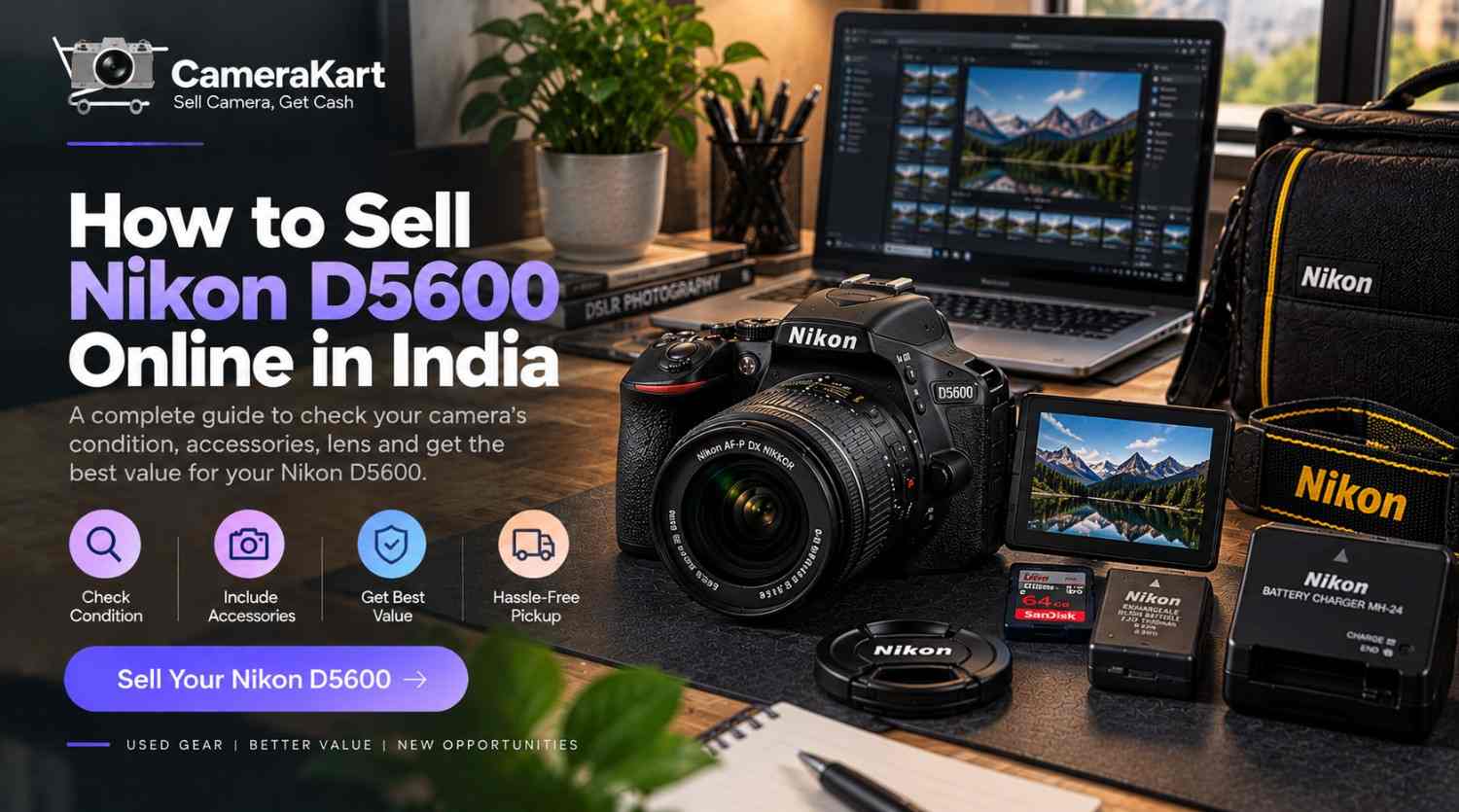
If you own a Nikon D5600 and are planning to sell it, don’t judge the camera only by its age or outer appearance. For a used DSLR, the condition of the body, shutter, sensor, autofocus, LCD, lens, battery and included accessories can all be relevant when the camera is evaluated.
The Nikon D5600 is a DX-format DSLR with a 24.2MP sensor, Nikon F mount, 39-point autofocus system, 5 fps continuous shooting, a 3.2-inch vari-angle touchscreen and Full HD video recording up to 60 fps. It also supports SnapBridge connectivity through Bluetooth/Wi-Fi.
If your D5600 is no longer your primary camera, you’re upgrading, or you simply have unused equipment, this guide will help you prepare it before you sell Nikon D5600 online.
You can also check the dedicated Nikon D5600 selling page on CameraKart.
Start With Your Nikon D5600 Kit
Before you decide how to sell your camera, first identify exactly what you have.
Your setup could contain:
- Nikon D5600 body
- NIKKOR lens
- Battery
- Battery charger
- Camera strap
- Body cap
- Front/rear lens caps
- Memory card
- Original box
- Purchase invoice
- Additional accessories
The D5600 uses the Nikon F bayonet mount and supports autofocus with compatible AF-S, AF-P and AF-I lenses.
So if you’re selling the camera together with a lens, inspect both separately instead of treating them as one item.
Check the Body From Top to Bottom
Before you sell used Nikon D5600, give the camera a proper physical inspection.
Pay attention to areas that receive frequent handling:
- Camera grip
- Mode dial
- Command dial
- Shutter button
- Battery compartment
- SD-card compartment
- Tripod socket
- Hot shoe
- USB port
- HDMI port
- Lens mount
- LCD screen
Look for scratches, dents, cracks, loose covers or signs of impact.
Normal cosmetic wear from regular photography is different from functional damage. If there is a known issue, it’s better to mention it accurately during the selling process.
Check the Shutter and Shooting History
For a DSLR such as the D5600, shutter usage is useful information to keep ready.
The D5600 supports continuous shooting at up to 5 frames per second under specified settings.
If you know the camera’s shutter count, keep that information available when you request an evaluation.
But don’t judge the entire camera only by shutter count.
Also consider:
- Overall body condition
- Sensor condition
- Lens condition
- Buttons and dials
- LCD
- Battery
- Previous maintenance
- Accessories
Two cameras with similar shutter counts can still be in very different physical conditions.
Inspect the Sensor Before Selling
The D5600 has a 24.2MP DX-format sensor and Nikon’s specifications include an image-sensor cleaning system.
For a basic inspection, use a clean lens and photograph a plain, evenly lit surface.
Then zoom into the image and look for persistent spots or unusual marks.
If you see dust spots, don’t automatically assume that the sensor has a serious problem. Sensor dust can sometimes be addressed through proper professional cleaning.
Avoid touching the sensor directly.
Give the NIKKOR Lens Its Own Inspection
If you’re selling your D5600 with a lens, the lens can make up an important part of the complete kit
Check:
Front element
Look for scratches, cracks, fungus or heavy marks.
Rear element
Inspect the rear glass and mount.
Focus ring
Rotate it and check for unusual resistance.
Zoom ring
If you’re using a zoom lens, make sure the movement is smooth.
Autofocus
Test autofocus through the camera.
Lens mount
Check for visible damage or excessive wear.
Also identify the exact lens model you’re including.
Instead of writing:
Nikon camera with lens
write something more specific such as:
Nikon D5600 + NIKKOR 18-55mm lens
That makes the equipment package much clearer.
Test the 39-Point Autofocus System
The D5600 uses Nikon’s Multi-CAM 4800 autofocus sensor module with 39 autofocus points, including 3D tracking.
Before you sell Nikon D5600 online, test autofocus in a few simple situations.
Stationary subject
Focus on an object at different distances.
Moving subject
Try continuous autofocus on a moving object.
3D tracking
Test subject tracking where appropriate.
Live View
Switch to Live View and check focusing there as well.
You’re not trying to perform a laboratory test. The purpose is simply to identify whether the camera’s basic focusing functions are working normally.
Test the Vari-Angle Touchscreen
The D5600 has a 3.2-inch vari-angle touchscreen LCD with approximately 1.037 million dots.
This is one area that should be checked carefully because the screen is frequently moved and touched.
Check:
- Touch response
- Screen brightness
- Display quality
- Dead pixels
- Scratches
- Hinged movement
- Live View
- Playback
- Menu navigation
Move the screen gently through its normal range and make sure there is no unusual looseness or damage.
Check the Optical Viewfinder
Unlike a mirrorless camera, the D5600 uses an optical DSLR viewfinder.
Look through it and check:
- Viewfinder clarity
- Eyepiece condition
- Diopter adjustment
- Dust or unusual marks
- Autofocus indicators
- Information display
The camera’s optical viewfinder has approximately 95% frame coverage horizontally and vertically according to Nikon’s specifications.
Test the Built-In Flash
The D5600 has a built-in flash with TTL/i-TTL flash control.
Pop the flash up and take a test photograph.
Check that:
- Flash opens properly
- Flash fires
- Exposure behaves normally
- Flash closes properly
If you rarely use the flash, it’s easy to forget about it when preparing an older DSLR for sale.
Record a Short Full HD Video
The D5600 supports Full HD 1920×1080 recording up to 60 fps, depending on the selected settings.
Record a short clip and check:
- Video starts normally
- Recording continues normally
- Autofocus behaves as expected
- Audio is recorded
- File saves correctly
- Playback works
You don’t need to test every frame-rate option.
A short practical test is enough to identify obvious problems.
Check the SD Card Slot
The D5600 uses SD, SDHC and SDXC cards and has one SD card slot.
Insert a compatible card and:
- Take a photograph.
- Record a short video.
- Review the files.
- Confirm the files are saved correctly.
- Remove your personal card after testing.
If you’re including a memory card with the camera, mention its capacity separately.
Check the Battery and Charger
The D5600 uses an EN-EL14a rechargeable Li-ion battery, with the Nikon MH-24 quick charger listed as compatible with the camera.
Check:
- Battery charges normally
- Battery holds charge
- Battery compartment is clean
- Charger works
- No physical battery damage
If you have an extra compatible battery, include it in your equipment list.
Don’t Forget SnapBridge and Wireless Connectivity
The D5600 supports SnapBridge, Bluetooth and Wi-Fi connectivity.
If wireless connectivity is important to you, test it before selling.
You don’t need to spend a lot of time configuring your phone. Just confirm that the relevant connectivity functions behave normally.
And before handing over the camera, remove your personal device connection and reset the camera settings where appropriate.
What Accessories Should You Include?
Before you sell my Nikon D5600, collect everything that belongs to the camera.
| Item | Check |
|---|---|
| D5600 body | Overall condition |
| Battery | Charging/condition |
| Charger | Working |
| Lens | Glass + autofocus |
| Body cap | Available |
| Lens caps | Available |
| Camera strap | Condition |
| SD card | If included |
| Original box | If available |
| Invoice | If available |
Nikon’s listed D5600 accessories include the EN-EL14a battery and MH-24 charger, while exact kit contents can vary depending on the original package.
Body Only or D5600 With Lens?
One important decision is what exactly you want to sell.
D5600 body only
This can make sense if you want to keep your NIKKOR lenses for another compatible Nikon camera.
D5600 + one lens
This creates a more complete package for someone looking for a camera-and-lens setup.
Complete D5600 kit
If you’re leaving DSLR photography or moving to another camera system, you may also have additional lenses or accessories that you no longer need.
The choice depends on which equipment you want to keep.
Clean It — But Don’t Overdo It
A basic cleaning before selling is useful.
You can:
- Wipe the exterior with an appropriate microfiber cloth
- Remove dust from the body
- Clean the lens exterior carefully
- Clean the LCD gently
- Remove dust from the camera bag
- Organize the accessories
Avoid aggressive cleaning methods or attempting repairs yourself.
The goal is to present the camera in its existing condition, not to make it appear different from what it actually is.
Keep Your Purchase Documents
If you still have the original invoice, box or other purchase documents, keep them together.
Also keep the camera’s serial number available when required.
Before handing over the camera:
- Back up your photographs
- Remove your SD card
- Disconnect personal devices
- Review wireless settings
- Reset personal settings where appropriate
This is especially relevant for a camera that has been connected to your smartphone through SnapBridge.
Why Are You Selling Your Nikon D5600?
The reason you’re selling can help you decide what equipment to include.
Upgrading your camera
You may have moved to a newer DSLR or mirrorless camera.
Moving to mirrorless
If you’re changing systems, you may decide to sell the D5600 along with compatible DSLR lenses.
Camera is not being used
If the camera spends most of its time stored away, you may prefer to evaluate its selling option.
Changing your photography requirements
Your current work may require different equipment than when you purchased the D5600.
How to Sell Nikon D5600 Online With CameraKart
Once you’ve checked your camera and collected the relevant accessories, you can submit the model and condition details for evaluation.
When you sell Nikon D5600 online, provide accurate information about:
- Body condition
- Shutter count, if available
- Lens included
- Accessories
- Battery condition
- Working condition
- Any known issues
CameraKart has a dedicated sell Nikon D5600 online page where you can start the process.
CameraKart’s current camera-selling workflow describes model selection, an offer/evaluation, pickup scheduling and payment after inspection.
Nikon D5600 Seller Checklist
Before submitting your camera, save this checklist:
Camera Body
☐ Body inspected
☐ Buttons tested
☐ Dials tested
☐ Ports checked
☐ Lens mount checked
☐ Shutter tested
Performance
☐ Sensor checked
☐ Autofocus tested
☐ Live View tested
☐ Built-in flash tested
☐ Video tested
☐ SD card tested
Display
☐ LCD tested
☐ Touchscreen tested
☐ Vari-angle movement checked
☐ Optical viewfinder checked
Accessories
☐ Battery
☐ Charger
☐ Body cap
☐ Lens
☐ Lens caps
☐ Strap
☐ Box/documents
Before Handover
☐ Photos backed up
☐ SD card removed
☐ Personal connections removed
☐ Settings reviewed/reset
Final Thoughts
If you’re planning to sell Nikon D5600 online in India, start by understanding the actual condition of your complete setup rather than focusing only on the camera’s age.
Check the 24.2MP DX sensor, 39-point autofocus system, shutter, LCD, optical viewfinder, built-in flash, lens, battery and SD card functionality before submitting the camera for evaluation. These are documented D5600 specifications from Nikon.
Once you’ve checked the equipment and gathered your accessories, you can visit the Sell Nikon D5600 page on CameraKart and provide your camera details.